What Happens If You Don't Wear Your Retainer After Braces?

August 24, 2026
Your teeth may start moving back into their original positions if you stop wearing your retainer. The movement can result in an incorrectly aligned bite with a gap tooth or teeth that start crowding. The severity and speed of the movement can be different with each individual. As orthodontists cannot predict who is likely to relapse and move the most, most patients are advised to wear their retainers for as long as possible after their braces have been removed.
If you wear your retainer only a few days a week, you take your retainer out for long periods of time, or you just found out your old retainer feels tight, then you are not the only one. The first thing you should do is understand the process and when you should seek professional help.
What Happens When You Stop Wearing Your Retainer?
If you wear your retainer, your teeth won’t move back into their original positions after braces, a process called orthodontic relapse. The movement of your teeth may start to cause your bite to feel incorrect, and teeth may start to move forward and touch.
Not wearing a retainer does not mean your teeth will go through drastic movement. Relapse is often unpredictable, and some people avoid relapsing, while some people do not. Orthodontists cannot predict which patients will avoid relapsing. Wearing a retainer for a long period of time is recommended because of this.
An annoying aspect of teeth shifting without a retainer is that you may not notice the shift right away. A small shift is not obvious when you look at yourself in the mirror every day. An indicator that a shift happens may first be mentally noting that your once comfortable retainer now fits tighter or no longer fits.
What May Happen After Retention Is Stopped | What You May Notice |
Teeth Become Misaligned | Minor change in appearance of your teeth |
Return to Crowding | Front teeth may become more crowded or rotated |
Reopening of Spaces | Small gaps may reappear |
Change in Bite | Teeth no longer meet correctly |
Change in fit of retainer | Old retainer may now feel tight or does not go on at all |
A retainer is not an accessory in the traditional sense after braces. It is a critical component of the treatment process to help sustain the results.
Why Do Teeth Move Back After Braces?

Adaptation of the surrounding tissues of the teeth may continue to allow teeth to move even after the removal of the orthodontic appliances, whereas other factors, including periodontal, gingival, growth related and aging-related, can influence the final position of the teeth.
During orthodontic treatment, each individual tooth is moved in the desired position by the application of controlled forces within the confines of the surrounding bone. Upon completion of treatment, the surrounding tissues and the fibers in the periodontal ligament must adapt to the new situation.
Some periodontal fibers continue exerting forces that move teeth a little back toward their original positions. The surrounding alveolar bone also starts remodeling to accommodate the new positions of the teeth. So, simply taking braces off does not permanently lock the teeth in their new positions.
The movement of teeth can be complicated by other factors. Your bite or occlusion can cause movement of the teeth. So can movement of the soft tissues around the teeth and normal aging or maturation. Some natural teeth movement occurs in the absence of braces as people get older.
There are a number of reasons teeth are able to move back to their old positions after braces, without this meaning that the treatment was a complete failure. Teeth are bioactive components of a dynamic system.
What factors can contribute to orthodontic relapse?
Factors | How It Affects Stability |
Periodontal fibers | Orthodontic treatment can cause teeth to move, so they retain the ability to move around |
Alveolar bone | Can remodel to accommodate the new positions of the teeth |
Occlusion | Stabilizes the teeth upper and lower teeth meet |
Soft tissues | Can position the teeth |
Growth and development | Changes involving the face and dental arches continue after treatment |
Aging | Natural movement and crowding of the |
Wisdom teeth get a lot of blamed for crowding after braces, but there is more to the story. They should not be automatically treated as the reason teeth have moved.
How Long Does It Take for Teeth to Shift Without a Retainer?
There really isn't a fair way to estimate the speed of teeth shifting without a retainer. Things like relapse risk are more concerning in the first few years after orthodontic treatment, but that doesn't mean teeth won't shift at other times.
So, there really isn't a medically adequate answer to questions like, “How many days can I go without my retainer?” or, “How fast do teeth move without a retainer?” that applies to everyone.
Two patients who have undergone what seems to be the same orthodontic treatment may experience extremely different levels of post-treatment changes. Things like the original malocclusion, tooth movements made during treatment, growth, biological factors, retention method and other individual factors have an impact on the overall stability.
The position of the stable teeth can be expected to move. Orthodontists take a conservative approach when there is uncertainty due to the impact of individual factors, the original treatment, and tooth movement during treatment.
Your best bet is not to see how many days you can cross to see if you get to a “safe” or “unsafe” spot. The safest route is to see if your retainer still fits and if you have been noticing any changes.
Do I Have to Wear a Retainer My Whole Life?

The expectation is that you have to wear a retainer for the rest of your life to stop your teeth from shifting after you wear braces. There is no set amount of time after braces that the teeth permanently stay in a stable position, so you always have to wear a retainer.
The word forever may sound discouraging, but retention should be thought of as maintenance. It should not be seen as another stint of orthodontic treatment.
The British Orthodontic Society’s advice states that teeth may continue to change throughout the aging process and, therefore, there is a need for long-term retention because the risk of movement is always there following the initial post-treatment period.
Your orthodontist may suggest a certain method of retention based on your treatment and on your individual case. Some patients are able to transition to wearing their retainer only at night or a few nights per week; however, there is no uniform plan that can be applied to everyone. It is important to follow your treating orthodontist’s instructions.
Retention Question | The practical answer |
Do braces really need retention? | Yes |
Will your teeth remain in place? | No, teeth will continue to change position |
Is there a major movement for everyone? | No, the degree of movement for everyone is different |
Can everyone maintain a uniform retention plan? | No |
Do teeth change naturally over time? | Yes |
The main idea is not to be afraid to stop wearing your retainer, but rather to understand that the position of the teeth that was gained through braces will need to be maintained.
If you have stopped wearing your retainer, do not assume that your orthodontic treatment was a waste. What is important now is whether your teeth have moved and whether your retainer still fits.
The consequences of missed wear cannot always be accounted for on a day-to-day basis. Because everyone responds differently to tooth movement, the only true way to determine the outcome of missed wear is by receiving an orthodontic assessment.
If your retainer feels comfortable, then you should continue to wear it per your orthodontist's retention instructions. If it has become tight, is difficult to seat, and/or is uncomfortable, DO NOT wear the retainer and immediately contact your orthodontist.
If you notice changes like crowding coming back, spaces reopening, or a change in your bite, you should also contact your orthodontist.
Situation | What to do |
You forget to wear retainer | Contact your orthodontist |
You wear retainer comfortably | Follow your retention instructions |
Retainer feels tight | Arrange professional advice rather than forcing it |
Teeth have visibly shifted | Orthodontic assessment needed |
Fixed retainer feels loose | Seek advice promptly |
The biggest thing you need to realize is that you don't need to beat yourself up. A missed retention period is definitely a situation that can be assessed and often managed, and ignoring the situation because you are worried about your orthodontist won't change anything.
This question is not the same as asking what happens if you stop wearing your retainer. When movement is visible, the focus becomes assessing what has happened and whether more orthodontic work is needed or if it can be addressed with retention.
My Retainer Feels Tight or Won't Fit, Can I Still Wear It?

If your retainer is no longer fitting or is feeling tight, then do not attempt to force it into place. A retainer that is loose may be an indication of movement, or even damage to the retainer, and this is something an orthodontist can check. This is especially important if you have a retainer and realize it no longer fits as it previously did.
Do not try to address this yourself by bending, heating up, modifying, or otherwise reshaping the appliance. Avoid wearing it, as damage or movement of the first order will be irreversible.
An orthodontist will be able to assess the retainer and the teeth, and determine what has happened since the last visit. From there, if the retainer is still a good fit, a new one may be needed, or other work may be needed.
What is a retainer assessment?
There are a number of things an orthodontist has to assess when looking at a retained position.
Tooth position
If teeth have moved or shifted from their original position
Retainer fit
If the appliance or retainer is still fitting in the correct position
Appliance
If the retainer is broken
Bite
If the upper and lower teeth touch in an abnormal position
Fixed retainer
If repairs have been made
Treatment options
If further treatment is necessary after retention or if the retainer has to be replaced
A retainer that is too tight does not mean you have to get braces again. It only means that an assessment is needed to determine what course of action is needed.
When Should you See an Orthodontist?
You need to see the orthodontist if your retainer doesn’t fit anymore, has become loose, or has broken, if your teeth have shifted, or if your bite has changed. You also need to make an appointment with the orthodontist if your retainer has broken or gone missing, and you’re not sure how to manage your orthodontic position.
A fixed or bonded lingual retainer is attached to the back of the teeth, meaning you don't have to remember to put it in your mouth. However, fixed retainers break. Monitoring fixed retainers is important because if the bonding becomes too loose, the wire can come free, and your teeth can come out of position.
Sign | Explanation |
Retainer does not fit | Tooth position or appliance condition changed |
Retainer is tight | Doesn't correspond to current tooth position |
Crowding | Orthodontic relapse |
Gaps are open | Tooth position changed |
Bite does not feel right | Alteration in the relationship of upper and lower teeth |
Fixed wire is loose | Tooth movement occurs |
Broken retainer | Replacement or evaluation required |
If any of these issues arise, do not wait for the issue to cause discomfort or make you notice it, come in to have it evaluated by the experts.
When Retainer Problems Call For Professional Help
If you are wondering whether you should use your old retainer, it’s good to get a professional opinion. An orthodontist will evaluate your current tooth position, review your treatment history, and assess your appliance to suggest next steps.
The steps that follow the assessment depend on what the orthodontist finds. In some cases, retention is still necessary. In other cases, a retainer replacement is needed. If your teeth have moved, then orthodontic treatment to restore the corrected position of your teeth is necessary.
Choosing an experienced orthodontic clinic is important. At Dental Aesthetics Lahore, an oral consultation will be able to give you a professional assessment of the position of your teeth and retainer and the bite, instead of making assumptions about how long you have not worn your retainer.
If you stopped wearing your retainer and are concerned about teeth shifting after braces, having it checked can provide a current status and the next best course of action.
Costs for addressing shifting teeth due to lack of retainer wear can vary greatly depending on whether assessment only, a new retainer, additional orthodontic treatment, or other remedial action is needed. A consultation is the correct first step, as the needed treatment cannot be determined without looking at the teeth and the appliance.
Retainer Types: What You Need to Know

Removable retainers may be made of a vacuum-formed or thermoformed clear material, a Hawley retainer, or a retainer which is bonded to the back of the teeth. For your specific case, the type of retainer and the length of time it is worn are based on the results of your orthodontic treatment.
There is no need to study retainer variants to the extent we have to understand the principle; each device has specific instructions which should come from your orthodontist.
Retainer type | Basic description |
Clear retainer/VFR | A removable device which is molded and fits around the teeth |
Hawley retainer | An appliance made of a wire and an acrylic frame which is removable |
Fixed/bonded retainer | A wire which is bonded to the back of selected teeth |
Thermoformed retainer | A removable thermoplastic device which is custom fitted to the teeth |
Routine cleaning and care of your retainer is a separate topic. It will have specific instructions attached to your appliance.
The Bottom Line: What Happens If You Stop Wearing Your Retainer?
To sum up what happens when you stop wearing your retainer, your teeth eventually move to their original position, though how much or how fast is unpredictable. Expect crowding or gaps, the changing of your bite, or a retainer that stops fitting after you remove it.
The real takeaway is that once braces come off, your teeth have not been fully realigned yet. This stage is the retention stage of orthodontic treatment, which, out of fairness to clinicians, means that we recommend continuous retention. This is because there is no way to tell someone how much movement will happen or if they will relapse.
There is no benefit to feeling embarrassed or putting off an assessment. If your retainer feels fine, then wear it as prescribed. If your retainer feels tight or if it does not go on, don’t force it. If you see that your teeth have shifted, then you need to see an orthodontist for an assessment.
Dental Aesthetics can help patients in Lahore with retainer problems, non-retainer, worn out, or lost retainer issues, by assessing your teeth position and advising you on the best way to proceed under your unique circumstances.
Frequently Asked Questions
What happens if you stop wearing your retainer?
If you stop wearing your retainer, your teeth may slowly return to the way they were before you had braces. They can start to become crowded, or there can even be large spaces that did not exist before. Teeth may rotate, or your bite may change. How much your teeth move after you stop wearing your retainer is unpredictable. Orthodontists can't say for sure which patients are going to move a great deal.
Do you have to wear a retainer for the rest of your life?
In most cases, some kind of long-term retention is needed to maintain the end result of orthodontic treatment. Retainers must be worn for the rest of your life because your teeth continue to move and change with age. It is impossible to say when retention may be discontinued safely for all patients.
Can you go a long time without wearing your retainer?
There is not a definitive number of days, weeks or months that can go by without wearing your retainer. The time it takes for teeth to begin moving and the amount of movement that occurs is unpredictable. If you have not been wearing your retainer, check the fit of your retainer and contact your orthodontist if you notice movements or changes in your bite.
Can teeth move after one night without a retainer?
Teeth do move without retention, but it is not possible to predict how much of a meaningful move will occur in an individual in one night. You do not want to assume teeth will move significantly just because you forgot to wear your retainer one time. Follow your orthodontist's instructions.
Can I wear my retainer that's a bit tight?
Don't use force on tight retainers, because tightness indicates that the retainer either no longer fits, your teeth moved, or the retainer is damaged. An orthodontist decides if the retainer is still good or if you need a new retainer, or even more treatment.
Will my teeth go straight again on their own?
Teeth want to go back to the way they were, but that doesn't mean that they will completely go straight on their own. The amount of orthodontic relapse is different from person to person, and there is no way to know that relapse will happen.
Can a retainer send my teeth back to where they were?
Retainers don't make your teeth go back the way they were. If they did, then maybe that would be the substitute for Orthodontic treatment. Orthodontists examine the situation and decide if a new retainer is required or if different treatment is needed.
Do fixed retainers completely stop relapse?
Not completely. While fixed retainers help, that doesn't mean that there won't be any relapse. Regular checks are still needed along with good oral hygiene. If a fixed retainer comes loose or falls off, that retainer should be looked at, since your teeth will want to eventually go back to how they were.
How do I determine if my teeth have shifted?
You may experience new crowding, gaps in your teeth, rotations, and a change in your bite. It may even change how you bite together. You may notice movement among your teeth, but it may be minor and unnoticeable to you. An orthodontic assessment is best to see if there is a change.
Is it still worth wearing my retainer?
A retention problem is not hopeless. What happens next depends on your teeth now and if your retainer still fits. Don't try to reuse an old retainer if it fits now but is tight; that is how you break teeth! Assessing by an expert orthodontist like the ones at Dental Aesthetics is the next best move.



Request An Appointment
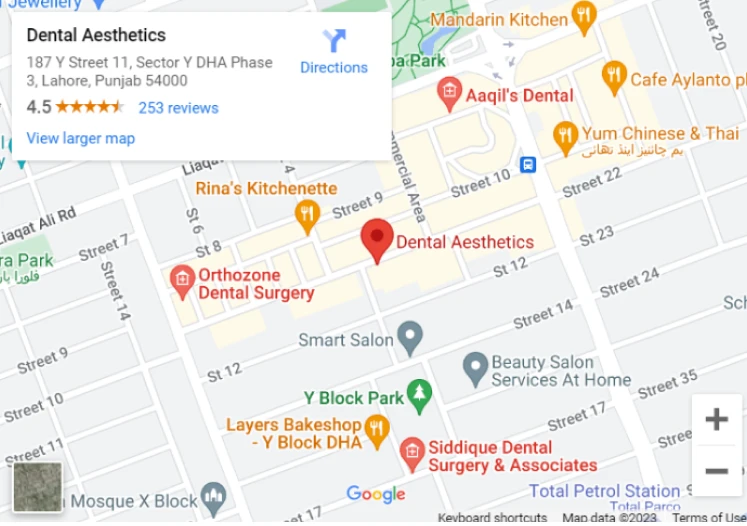
Map
Timings
Monday - Saturday
11:00 am - 9:30pm
Sunday
12:00pm - 8:00pm