Emergency Dental Pain Treatment: What Your Pain Is Telling You and How We Treat It

June 18, 2026
Severe tooth pain can affect so many daily activities. It can make sleeping, eating, and speaking comfortable almost impossible. When patients visit our clinic for emergency dental pain treatment, they usually only have one question: "Why does the pain hurt so much?"
The answer is often not easy. The cause of your pain is often hidden from view. Pain often resides within the tooth and the supporting structures that can't be seen without clinical tests and imaging. It helps to know the cause of the pain when trying to figure out the emergency tooth pain relief that will best help your situation. When the pain is severe enough that you will do anything for relief, the situation warrants a trip to the dentist.
This guide helps you better understand the type of severe pain that mandates a trip to the dentist, how expert dentists at Dental Aesthetics diagnose the source of the pain, and the treatment that will be provided.
When is Dental Pain an Emergency?
Dental pain is an emergency when it is constant, worsening, and painful enough to disrupt sleep and your daily activities. In these cases, your pain has likely caused damage to the tooth that will not fix itself without a dentist's help.
Many patients think that severe pain will eventually go away on its own. Unfortunately, tooth pain that is considered an emergency signals that there is an infection, inflammation, or an emergency-level situation that is quickly deteriorating the structure of the tooth. Symptoms can come and go; however, the situation will continue to get worse.
Sensitive Mild Pain vs Emergency Pain
Mild Sensitivity | Emergency Dental Pain |
Triggered by hot or cold food | Occurs spontaneously |
Lasts a few seconds | Last minutes or hours |
Improves after stimulus removal | Persists after stimulus removal |
Usually manageable | Interferes with sleep and daily activities |
May be reversible | Usually requires urgent dental care |
It is advisable to seek emergency dental care if your pain has gotten to the point where it wakes you up at night and is difficult to ignore. This should be done within 24 to 48 hours of the pain worsening.
What's Happening Inside Your Tooth When Pain Gets Severe
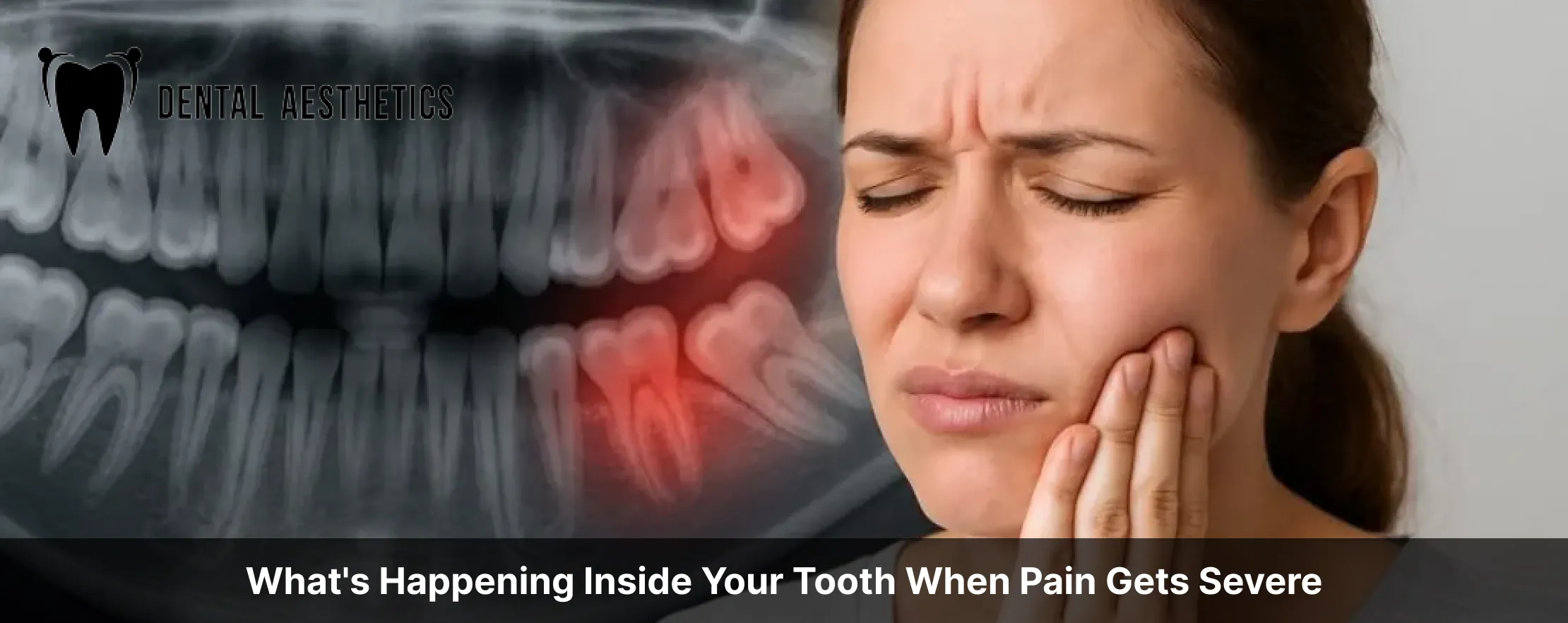
When the pain gets this severe, inflammation and infection have most likely spread to the dental pulp, which is the innermost, most sensitive, and most damaging to the structural integrity of the tooth. This area contains nerves and the blood supply to the tooth. The dental pulp is easy to under stress and will experience pain in response to the slightest inflammation.
Irreversible Pulpitis
Irreversible pulpitis is the most common and most diagnosed cause of severe, spontaneous, and emergency-level tooth inflammation.
During the early phases, decay and tiny fractures can result in brief heightened sensitivity. At this stage, pulp can still heal if the irritant is removed. However, when the inflammation reaches an irreversible stage, the tissue will undergo necrosis.
Patients with irreversible pulpitis normally suffer a throbbing pain that occurs spontaneously with no apparent stimulus. The pain is often the worst during the night and can be prolonged even after removal of thermal insults.
The pain is often poorly localised because the inflamed pulp can refer pain to surrounding teeth, the mandible, and even the ear. This is why it is critical to investigate fully before commencing treatment.
Feature | Reversible Pulpitis | Irreversible Pulpitis |
Sensitivity duration | Brief | Prolonged |
Spontaneous pain | Rare | Common |
Night pain | Uncommon | Common |
Pulp Recovery Possible | Yes | No |
Typical treatment | Filling | Root canal therapy or extraction |
The pulp will become necrotic if irreversible pulpitis is left untreated.
Periapical Abscess (Infection at the Root Tip)
A periapical abscess occurs when a necrotic tooth pulp allows bacteria to form a cavity of pus at the apex of a tooth. This results in constant pain and swelling and is a common result of untreated irreversible pulpitis.
With a necrotic tooth nerve, bacteria will enter the root canal system, and the body's immune response will initiate an inflammatory response in the surrounding periapical tissue, and pus will be formed.
Tooth pain often requires treatment when the pain becomes consistent and worse during the chewing process. It can become localized. The affected tooth is often elevated and tender. Near the parulis, which is a small gum swelling and a type of fistula, the swelling may become more noticeable. Within a more advanced stage, the swelling may become more extensive and could spread to the face, jaw, and soft tissue.
A fever could mean there is an infection that may be spreading and requires emergency dental treatment.
Clinical Signs and their Meanings:
Pain while chewing: Periapical inflammation
Swelling in the gums: Localized abscess
Swelling in the face: Infection spreading
Fever: Infection spreading
Pus drainage: Infected
Cracked Tooth with Exposed Pulp
A tooth that is cracked can be very painful and cause symptoms of quick and sharp pain while chewing. This is often because the crack is flexed and opened while the nerve is exposed. This can also be misdiagnosed because often, symptoms may not be consistent.
Cracks may be due to trauma, grinding, or even chewing hard objects. Some may be confined to the outer layers, while others may be even deeper and be involved in the dental pulp.
Teeth that are cracked may be similar to treating irreversible pulpitis in that they may now be involved and be very painful and inflamed. The method that is most used for treating teeth that are cracked is dependent on the crack, the direction, and the depth of the fracture.
How is Emergency Dental Pain Actually Managed?


It is critical to determine the cause of the pain rather than simply treating the symptom. Diagnosing the cause of pain helps determine if the pain is due to the inflammation of the tissue, if it’s an infection, if it is a fracture, or if it is a combination of these issues.
Assessing the patient usually involves multiple tests. This may include assessing the patient’s bite and taking several imaging studies. To view the surrounding tissue and the root of the teeth, a periapical radiograph is a common imaging study. For complex cases, a three-dimensional imaging study using a CBCT may be warranted.
Clinical exams test the area of concern and assist in determining the source of pain and the symptoms. Percussion is used to test the area of concern and is helpful in determining the level of inflammation of the root. A thermal test is used to assess the vitality of the pulp. A periapical radiograph is used to visualize the root and surrounding structures. A CBCT is used to assess the area in three-dimensional detail.
Pulp extirpation is the best form of emergency treatment to alleviate a toothache caused by irreversible pulpitis. This is the removal of the inflamed pulp and nerve tissue. Local anesthesia is used to lessen the pain. This is also the first step of a root canal.
Root canal therapy is the treatment of choice when a periapical abscess is present. All of the infected tissue is removed from the canal, and it is then disinfected. A temporary restoration may be used prior to the complete restoration of the tooth. Incision and drainage are necessary when there is significant swelling. This is used to relieve the pressure of the infection and provide relief. This is also used to complete the treatment of the infected tooth.
Severe fractures and extensive decay or trauma to the bone make some teeth unreparable. In these cases, the best treatment option is to extract the tooth.
Amoxicillin and metronidazole may help manage the systemic infection signs. Antibiotics do not eliminate the source of a dental infection and should not be considered a replacement for treatment.
Why Painkillers Alone Won't Fix Emergency Tooth Pain

Painkillers are not a dental solution. They provide temporary comfort, but they do not treat the dental problem. Emergency treatment involves addressing the infection or inflammation.
Painkillers are generally sought when patients are unable to resolve the discomfort. During this time, the dental problem continues to advance and grow. For example, a tooth that has necrotic pulp with a developing periapical abscess continues to produce bacteria regardless of symptom suppression. Painkillers, such as Ibuprofen or Paracetamol, may provide temporary symptom relief, but do not resolve the infection.
Patients feel like the painkillers provide temporary relief, but the treatment is no longer effective because the infection has advanced.
If you are looking for treatment recommendations, see our "Which Pain Tablets Are Safe for Temporary Relief" Guide for detailed information.
What Happens If You Delay Emergency Dental Pain Treatment
Many people think they can put off emergency dental treatment for pain management. The most severe symptoms may go away on their own for days, weeks, or even longer. The disease, however, continues progressing. Dental infections are not designed to stay still. The inflammation will deepen and eventually affect the bone and soft tissue that surrounds the dental structure.
Translating from soft tissue to bone happens more quickly for teeth with necrotic pulp. Once the bacterial infection reaches that necrosis, the advanced decay will affect the tissue surrounding the apex of the root. The result is the painful swelling that everybody knows is time to go to the dentist
The severity of required dental treatment is directly proportional to the time that treatment is postponed.
Because of the necrosis and decay, teeth that are infected and decayed beyond pulp tissue are lost to the less preferred option of extracting the tooth.
Stage | What's Happening | Typical Treatment |
Reversible inflammation | Mild pulp irritation | Filling or restoration |
Irreversible pulpitis | Severe nerve inflammation | Root canal therapy |
Pulp necrosis | Nerve tissue death | Root canal therapy |
Periapical abscess | Infection beyond the root tip | Root canal, drainage, and antibiotics if indicated |
Advanced destruction | Extensive structural damage | Tooth extraction |
For several reasons, the best option is always to avoid delaying treatment. Ignoring the pain never resolves the problem.
When It's Necessary To Go To The Hospital Instead
You should visit the hospital instead of a dental clinic if you’re experiencing swelling that is moving towards the eye or throat. If you have a fever over 101°F (38.3°C) or are having trouble swallowing or breathing, those are also signs that you should visit an emergency room. These can be signs that an infection is worsening and needs an emergency response.
Most dental emergencies can be handled within a dental clinic, but some of them will begin to spread into the tissue of the face and start to threaten the airway and other deeper structures.
You should also go to the emergency room if you are experiencing trismus, or are unable to open your mouth fully, or if you have been injured and are experiencing uncontrolled bleeding.
Warning Sign | Why It Matters |
Difficult to breathe | Potentially an airway emergency |
Difficulty swallowing | May be obstructed by a deep-space infection |
Swelling near the eye | Risk of infection spread |
Fever over 101°F (38.3°C) | Maybe systemic infection |
Uncontrolled bleeding | Severe tissue involvement |
All of these signs may be potentially complicated if you do not seek emergency care.
Emergency Dental Care on the Same Day in Lahore
The best way to treat emergency dental pain is to diagnose and resolve the cause of it. Delaying treatment can worsen infections and cause other complications that make treating the infection more complex.
Dental Aesthetics offers same-day emergency appointments/24-hour emergency dental services in Lahore for patients in need of treatment for pain, dental infections, and other urgent dental services.
Dr. Shahzad Mirza, King's College London alumnus, manages complex emergency cases with a multidisciplinary team that includes a maxillofacial surgeon. Services include root canal treatment, surgical extraction, abscess drainage and emergency treatment for acute dental infections.
For general information on dental emergencies, please reach out to the expert team over at Dental Aesthetics Lahore.
Frequently Asked Questions (FAQs)
Q. Does emergency tooth pain go away on its own?
Constant, severe emergency tooth pain does not go away on its own. While symptoms may lessen for a brief time, the infection or inflammation will continue to get worse. Pulp necrosis, the death of the tooth’s nerve, may happen even if the pain goes away. Only a dental professional can determine what will happen to the infected tooth after symptoms subside.
Q. Can you take ibuprofen and paracetamol together for tooth pain?
Tooth pain can be treated by using ibuprofen in combination with paracetamol, as long as the patient follows medical guidelines. Symptoms will be managed, but the cause will remain. Tooth pain that persists even after medication needs to be assessed by a dental professional.
Q. How long is too long to wait to see a dentist for tooth pain?
Tooth pain should be assessed and treated by a dental professional within 24 to 48 hours. Pain that is constant and throbbing or pain that is severe enough to cause an interruption in sleep needs urgent and emergency dental treatment. Usually, earlier treatment means treatment can be simpler and may lessen the chance of the infection spreading.
Q. What happens during an emergency root canal?
During an emergency root canal, the inflamed/infected pulp tissue is removed to address the pain. This is done under local anesthetic and often results in a significant reduction in pain immediately after the procedure. The canals will continue to be cleaned and disinfected, and a temporary restoration will be put in place to protect them until a final restoration is able to be done.



Request An Appointment
Map
Timings
Monday - Saturday
11:00 am - 9:30pm
Sunday
12:00pm - 8:00pm