


Dental Inlays vs Onlays: Which One Is Right for Your Tooth?
September 3, 2026
Learning about dental inlays vs. onlays can help you make a better-informed decision about your treatment if your dentist has said a standard filling might not be enough. An inlay fits inside the grooves of a tooth, and an onlay goes over one or more cusps, the raised points of a chewing tooth. They are also both indirect restorations, meaning they are fabricated outside of the mouth and then bonded to the tooth. This will depend on how much healthy tooth is present and whether or not the cusps require additional protection.
The assessment of a damaged posterior tooth at Dental Aesthetics Lahore determines the amount of sound tooth structure and the need for cusp coverage. The dentist does not choose an inlay or onlay based on the size of the cavity alone, but also takes into account the remaining structure of the tooth, the bite, existing restorations and overall condition.
What is the Difference between Inlays and Onlays?
The main difference between an inlay and onlay is the amount of tooth covered by the restoration. An inlay is placed within the cusps of the tooth, whereas an onlay covers one or more cusps and part of the chewing surface.
Both are types of indirect fillings sometimes called indirect restorations. An inlay or onlay, compared to a direct filling that is sculpted into the tooth during the appointment, is custom-made from an impression or digital scan and then bonded or cemented into the prepared tooth.
An inlay might be suitable where decay, an old filling or other damage is mostly within healthy cusps. Now if one or more cusps have become weakened and need to be covered, an onlay is used.
A zirconia crown treatment in Lahore is a different story. Instead of restoring a specific area of the tooth, it provides coverage around most or all of the visible tooth.
Restoration | What is included? | Typical Role |
Direct filling | The cavity itself | Areas of small to moderate damage |
Inlay | Inside the cusps | Larger holes where cusps are still suitable |
Onlay | Inside the tooth + 1 or more cusps | Damage involving or weakening cusps |
Full crown | Most or all of the visible tooth surface | Most or all of the visible tooth surface |
The key thing to understand about dental inlays vs onlays is that neither is automatically a better restoration. The dentist will select depending on the condition of the individual tooth.
It’s a distinction that matters a lot to someone who has just been told a filling is not enough anymore. The goal is usually to restore the tooth while minimizing the amount of healthy tooth structure that must be removed.
Inlay vs Onlay vs Filling vs Crown: What's the Difference?
A filling, inlay, onlay and crown differ mainly in how much tooth they restore or cover, how they are made and how much tooth preparation is needed. Your dentist will select one based on the amount and location of damage.
Feature | Direct filling | Inlay | Onlay | Full crown |
Coverage | Cavity | Between cusps | One or more cusps | Most/all visible tooth |
Fabrication | Inside mouth | Outside mouth | Outside mouth | Outside mouth |
Retention | Bonded directly in cavity | Bonded/cemented | Bonded/cemented | Cemented/bonded over prepared tooth |
Tooth preparation | Generally least extensive | More extensive than a filling | More extensive than an inlay | Usually most extensive |
Common location | Front and back teeth | Mostly premolars/molars | Mostly premolars/molars | Front or back depending on need |
Appointments | Usually one | Often two | Often two | Usually two or more |
Cost tendency | Lower | Higher | Higher | Generally higher |
There is no universal “best” restoration in this table. For example, placing a crown on a tooth that could appropriately be treated with a more conservative restoration may involve unnecessary tooth preparation. Conversely, choosing an inlay when a cusp requires protection may not provide the coverage the tooth needs.
That is why a consultation at a restorative dental clinic in Lahore should focus on the condition of your tooth rather than simply the price or appearance of the restoration.
When Would a Dentist Recommend an Inlay Instead of an Onlay?
An inlay is generally considered when the damage is confined between the cusps, while an onlay may be recommended when decay, a fracture or a large cavity has weakened one or more cusps.
This is particularly relevant for posterior teeth such as premolars and molars, which experience substantial chewing forces. Consider a mesial-occlusal-distal (MOD) cavity preparation. In layman's terms, this is a hole that goes through the middle chewing surface and both sides of the tooth. If a lot of tooth structure has been removed, the remaining cusps may need extra protection.
An inlay is a substitute filling for the inside of the tooth, without covering the cusps . An onlay covers selected cusps, allowing the restoration to support or protect areas which have lost strength.
Clinical reasoning | Restoration Considerations | Tooth condition |
Small to moderate cavity | Direct filling | Minimal loss of structure |
Large cavity between intact cusps | Inlay | Restores internal tooth structure |
Compromised or weakened cusp | Onlay | Cusp coverage |
Extensive loss of visible tooth structure | Crown or other full coverage option | Possibly more extensive protection needed |
Large MOD prep | Inlay, onlay or crown based on remaining structure | Choice based on cusp condition and remaining tooth structure |
This is not a diagnostic checklist for self-diagnosis by patients. The dentist will need to evaluate the tooth, the existing restoration, the remaining dentin, any cracks, the bite and the pulp health.
At Dental Aesthetics Lahore, restorative care is described as the conservation of whatever tooth structure is left, while also treating the diseased or decayed areas. The clinic lists restorative treatments such as fillings and crowns, so a restorative consultation is a practical starting point if you have been told that your existing filling is no longer adequate.
If you are considering dental inlays vs onlays due to a large cavity or old filling, ask your dentist specifically, “How much healthy tooth structure is left and does this tooth need cusp coverage?”
What Materials Are Inlays and Onlays Made Of?
Inlays and onlays can be manufactured from ceramic or porcelain, composite resin and gold. The choice of material depends on the tooth, functional requirements, esthetics and the treatment workflow available.
Ceramic and porcelain are popular when tooth color is important. Modern ceramic restorations are also well represented in the clinical research of indirect restorations. Composite resin can be used for indirect restorations as well. However, evidence comparing resin and ceramic indirect restorations suggests that ceramic restorations have strong survival data for medium and long-term.
Gold is a well-known material for indirect restorations and has a long clinical history, especially where durability under chewing forces is important. The metallic appearance may not be the first choice for patients seeking a tooth colored result.
Dental Aesthetics currently lists porcelain inlays and onlays in its restorative-care information and publishes CEREC digital fabrication information. The clinic should be consulted as to suitable materials and fabrication options currently available for your particular case.
Material | Appearance | Main consideration |
Ceramic/porcelain | Tooth-coloured | Good aesthetic appeal, and considerable clinical evidence |
Composite resin | Tooth colored | Useful restorative material but long-term evidence generally less favorable than ceramic |
Gold | Metallic | Established choice with long clinical history |
When considering ceramic vs composite vs gold inlay, the decision should not be based on material alone. Tooth position, forces of mastication, esthetics, residual structure and the dentist's restorative plan all contribute.
How Long Do Inlays & Onlays Really Last?
Ceramic inlays and onlays have a good documented survival rate, with one large meta-analysis estimating survival at 92 to 95% at 5 years and 91% at 10 years, while another systematic review found ceramic onlay survival of 91 to 100% at 2 to 5 years and 71 to 98.5% beyond 5 years. These are survival estimates based on the studies and not a guaranteed lifespan for a single restoration.
This is important because many articles describe inlays and onlays as “long-lasting” without specifying what that means clinically. In 2016, a systematic review and meta-analysis of more than 5,800 ceramic inlays, onlays, and overlays estimated survival to be 92-95% at five years and 91% at 10 years. The most reported failure category was fracture or chipping, followed by endodontic complications, secondary caries, and debonding.
Another systematic review in 2018 of 21 clinical studies specifically on ceramic onlays showed survival rates of 91-100% at two to five years. The range was wider (71-98.5%) for follow-up beyond 5 years. Fracture was the most common cause of failure, followed by debonding and caries.
Clinical Evidence | Follow-Up | Reported Survival |
Ceramic onlays | 2-5 years | 91-100 % |
Ceramic onlays | 5 Years | 71-98.5% |
Ceramic inlays/onlays/overlays | 5 years | 92-95% |
Ceramic inlays/onlays/ overlays | 10 years | 91% |
Why is the long term span so broad? Factors such as the position of the tooth, the amount of remaining tooth structure, the design of the restoration, oral hygiene, bite forces, and parafunctional habits like grinding influence the outcomes.
The systematic review in 2018 found an increased risk of failure associated with non-vital teeth, more posterior teeth, and patients with parafunctional habits. If you are asking how long inlays and onlays last, there is not a single number that applies to everyone.
A dentist can provide a more useful answer by looking at the design of the restoration, the remaining tooth structure, and the functional demands on that particular tooth.
Onlay or Crown: Do I Need an Onlay or a Crown?
An onlay will usually require less removal of healthy coronal tooth structure than a full crown. However, current evidence is insufficient to conclude that onlays are superior to crowns in general. This is one of the most important nuances in the inlay onlay vs crown debate.
Michaud and Dort (2023) did a systematic review on posterior teeth with MOD tooth structure loss and concluded that onlays are more conservative of tooth structure. The review could not make a meaningful overall comparison between onlays and crowns due to lack of evidence, although failures involving onlays seemed less catastrophic and possibly more salvageable.
The same review reported that onlay preparation can remove approximately 20–45% less coronal tooth structure compared to crown preparation.
Onlay vs. Crown Considerations | What Does the Evidence Say |
Tooth structure removed | Onlay preparation generally removes less |
Overall long-term | Not proven |
Short-term survival | Evidence suggests broadly similar outcomes |
Failure pattern | Onlay failures may be less catastrophic |
Salvageability | In some situations, failed onlays may be more repairable |
A separate systematic review and meta-analysis from 2022 found no statistically significant difference in survival between tooth colored onlays/partial crowns and full crowns at 1- and 3-years, but the authors stated that further long-term evidence is needed.
If there is enough tooth structure left on your tooth for an onlay, then saving more healthy tooth may be an important consideration. But if the tooth is too compromised structurally for an onlay, then we may need to place a full crown.
At Dental Aesthetics Lahore, you can discuss the restorative alternatives available for your tooth instead of assuming that a crown or onlay is automatically appropriate.
What's the Dental Inlays and Onlays Procedure Like?
Traditional inlay or onlay is usually a two-visit procedure where the tooth is prepared and scanned or impressed on the first visit and the finished restoration fitted and bonded on the second.
The process usually starts with an assessment of the tooth. The dentist will look at the existing filling or decay, the amount of tooth structure remaining, the cusps, the bite, and, if necessary, the pulp condition. Preparation involves removal of decayed or damaged tooth structure and shaping the tooth to receive the restoration.
Then an impression or digital scan of the prepared tooth is taken. A temporary restoration may be placed while the final restoration is being fabricated out of the mouth. At the next visit, the inlay or onlay is tried for fit, contacts, appearance, and bite before being bonded or cemented. The restorative care page of Dental Aesthetics says that standard porcelain inlays and onlays have generally needed fabrication in a lab and multiple appointments, but CEREC technology can precision mill appropriate porcelain restorations in a single office visit.
The clinic also publishes information on same-day CEREC crowns and digital CAD/CAM workflows. Patients thinking about inlay onlay procedure steps at Dental Aesthetics can ask if their specific tooth is suitable for a digital same-day workflow.
Examination: The tooth and its surrounding structures are examined
Preparation: Remove decayed or compromised material
Scan/impression: Image of the prepared tooth
Temporary restoration: When final restoration needs to be fabricated
Fabrication: Restoration is fabricated using the chosen workflow
Try-in: Check fit and contacts, aesthetics, and bite
Bonding: Restoration is bonded/luted
Final Check: Bite and margins review
Is There Any Sensitivity After Inlay or Onlay Placement?
After an inlay or onlay is placed, there can be some temporary sensitivity to hot or cold. This sensitivity should generally become less noticeable rather than progressively worse. The tooth is now prepared and bonded and may be a little sensitive in the short term. It's the nature of the symptoms that counts.
If you experience continued sensitivity or increased pain when biting, or symptoms that don’t go away, be sure to contact the dentist who placed the restoration so the tooth can be evaluated. As part of the restorative-care process, Dental Aesthetics patients can discuss any concerns they have after treatment with the treating dental team.
The point isn’t to make dental inlays vs onlays sound scary. Most importantly, patients need to know what to expect after treatment and when it is appropriate to contact their dentist.
Why are Inlays and Onlays More Expensive Than Fillings?
Inlays and onlays are generally more costly than direct fillings, not due to the material being more expensive but because of the extra preparation, custom fabrication and clinical time involved.
A direct composite filling is typically formed and polished in the mouth in a single visit. Inlays and onlays are more controlled preparations, and custom fabricated restorations that are bonded into position.
Prices are indicative and may vary depending on laboratory costs, digital fabrication, preparation complexity and material selected.
The laboratory fees and the extra visit are important factors as to why an inlay might end up costing much more than a direct composite filling, says a Lahore dental clinic. That accounts for the difference in cost, but should not be taken as a universal Lahore price.
Cost factor | How this can impact the fee |
Material | Ceramic, composite and gold are priced differently |
Tooth complexity | More complex preparation may take more clinical time |
Laboratory work | Need to fabricate traditional indirect restorations |
Digital workflow | Scanning and milling require specialist technology |
Number of visits | More appointments increase clinic time |
Existing restoration | Removing a large or failing restoration can add complexity |
Therefore, searching the web for the average price of an inlay or onlay may not reflect the real price of your specific treatment.
The best way forward for Dental Aesthetics Lahore is to get the tooth examined first and then be told specifically what treatment is recommended, what restoration material will be used, and the costs involved.
Best Clinic in Lahore for Dental Inlays vs Onlays
If you have been told you need an inlay, an onlay or a crown then a consultation with Dental Esthetics Lahore is a practical starting point. The restorative dental care they offer is designed around the condition of the individual tooth.
The clinic says its restorative approach is to save as much of the remaining tooth structure as possible and to remove only the diseased or decayed tooth structure. It offers restorative services like fillings and crowns and has published information about porcelain inlays/onlays and CEREC digital fabrication.
Dental Aesthetics has a team of trained dental specialists and offers restorative and cosmetic dental services. If you’re weighing dental inlays vs. onlays, the benefit of a consultation is that you can go over the entire treatment picture:
What to talk about | Why it matters |
Filling vs inlay/onlay | Determines if cusp coverage is needed |
Onlay vs crown | Considers preservation of tooth against structural requirements |
Material | Consideration of aesthetic, functional, and clinical requirements |
Digital vs traditional workflow | Explains the fabrication process |
Number of visits | Aids you in planning treatment |
Cost | Provides a quote for the specific case |
Follow-up | Details on what to expect after placement |
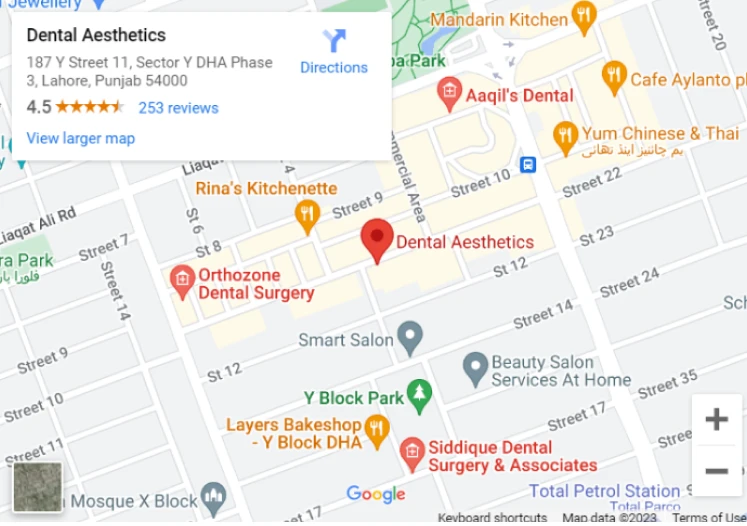
Dental Aesthetics has now 3 locations in Lahore at DHA Phase 3, DHA Raya Phase 6 and Gold Crest Mall, DHA Phase 4. The published opening hours are Monday-Saturday 11:00 am-9:30 pm and Sunday 12:00 pm-8:00 pm.
If you have been told that your filling is too large, a cusp is weakened, or your tooth may need a crown, a consultation can help you understand if an inlay, onlay, crown, or another restorative approach is appropriate.
Conclusion: Dental Inlays Vs Onlays: Which One Is Best For Your Tooth?
Dental inlays and onlays differ in the amount of healthy tooth structure that is remaining and whether the cusps require protection. An inlay is placed between the cusps; an onlay covers the cusps for more coverage.
A large meta-analysis estimated survival rates of 92-95% at five years and 91% at 10 years, supporting ceramic indirect restorations as a well-researched treatment modality. Another systematic review reported survival of ceramic onlays of 91-100% at two to five years and 71-98.5% longer than five years.
In suitable preparations, onlays can also save far more tooth structure than full crowns. However, current evidence does not provide evidence that an onlay is more durable or clinically better than a crown.
If you are in Lahore and have been told you need a large filling replaced, a weakened cusp protected, or an indirect restoration considered, Dental Aesthetics can give you a restorative assessment and discuss with you the treatment pathway available to you. Restorative-care offerings include fillings, crowns, porcelain inlays/onlays, and digital CEREC workflows.
Frequently Asked Questions
Is a molar better with an inlay or onlay?
Neither is better automatically for every molar. Molars are subjected to high masticatory forces. Before selecting a suitable restoration, the dentist takes into account the amount of remaining tooth structure, condition of the cusps, size of the cavity, bite and any existing restorations.
Are inlays and onlays 2 visits to the dentist?
Traditional lab-made restorations usually require two appointments. Dental Esthetics also has information on CEREC technology that may enable suitable restorations to be designed and fabricated in one visit. See if your tooth is eligible for this workflow.
Can an inlay or onlay replace an old filling?
Yes, where appropriate. A large filling that is breaking down or failing can weaken the tooth structure around it. Your dentist can see the restoration that is already there and can tell you if it makes sense to replace it with an inlay, onlay or crown.
How do I know if I need an onlay or a filling?
By the visible size of cavity alone you cannot reliably tell this. It is contingent upon cusp involvement, cracks, remaining dentin, existing restorations, bite forces, etc. Before choosing an onlay, a dental examination is required.
Are gold inlays still used today?
Yes. Gold still remains an accepted indirect restorative material with a long clinical history. However, ceramic or porcelain may be the material of choice where a tooth colored appearance is important. Ask your dentist which materials are appropriate for your tooth at the moment.
Do inlays and onlays look natural?
Inlays and onlays of tooth-coloured ceramic and porcelain can be made to match the adjoining teeth. The ultimate outcome is dependent upon the material, shade, translucency, restoration design, bonding and condition of the natural tooth.
Is an onlay the same as a partial crown?
The terms are similar but not always synonymous. An onlay is a form of partial coverage for the tooth that includes one or more cusps. “Partial crown” is a more general term and can mean restorations that give partial rather than full coverage.
How long does an inlay/onlay procedure take?
In traditional treatment, you will usually have one appointment for preparation and scanning or impressions and a second appointment for fitting and bonding. Digital workflows can reduce the time for appropriate cases, so ask your dentist about the workflow possible for you for your tooth



Request An Appointment
Map
Timings
Monday - Saturday
11:00 am - 9:30pm
Sunday
12:00pm - 8:00pm