

E.max vs Zirconia Crowns: Strength, Looks, Front vs Back Teeth and Cost in Pakistan
September 14, 2026
When given the choice between E.max and Zirconia Crown Treatment in lahore by your dentist, the choice shouldn't be based on which material is stronger, more attractive, etc. E.max is a lithium disilicate glass-ceramic that is strong and has good optical properties. Zirconia is a ceramic that also has good optical properties; however, it comes in many different formulations.
E.max can be relevant when trying to achieve natural translucency in certain anterior cases. On the other hand, zirconia can be relevant when the situation calls for higher mechanical demands, i.e., in the posterior region, or when space is limited. Other considerations include the remaining tooth structure, bite, the color of the crown (shade), how the crown is prepared, the cement, and whether you clench or grind your teeth.
Feature | E.max | Zirconia |
Material | Lithium disilicate glass ceramic | Zirconium dioxide ceramic |
Optical appearance | Translucent | Translucent to opaque, varies by formulation |
Strength | High, for a glass-ceramic | Generally higher, depending on formulation |
Common discussion | Anterior and selected posterior cases | Posterior, and high-load situations |
Versions | CAD and pressed forms | Monolithic and layered forms |
Clinical consideration | Bonding | Formulation, design, and surface treatment |
What Is the Difference Between E.max and Zirconia Crowns?
E.max and zirconia crowns differ in their ceramic composition. E.max is comprised of lithium disilicate glass ceramic, and zirconia crowns are composed of zirconium dioxide. Strength, translucency, and the clinical indications of the two crowns differ because of their composition.
What is an E.max Crown?
IPS e.max is the name of a family of all-ceramic materials from Ivoclar. IPS e.max CAD is a lithium disilicate glass-ceramic that is reported to achieve a manufacturer-reported biaxial flexural strength of 530 MPa after crystallization. Ivoclar offers multiple translucency levels and shades for optical customization.
A major reason lithium disilicate is used for aesthetic restorations is because of its strength and light transmission.
E.max is not a cosmetic material only. It can also be used for some posterior crowns, although the dentist needs to assess thickness, preparation, occlusal forces, and the indication for use.
What is a Zirconia Crown and What is the Difference Between Monolithic and Layered?
Zirconia is a ceramic made from zirconium dioxide. An important distinction is that "zirconia" is not a single material with a single strength and appearance.
A monolithic zirconia crown is milled primarily from zirconia and has no veneering porcelain on its functional surface.
A layered zirconia crown has a zirconia framework or core with a porcelain veneer.
Modern zirconia formulations vary greatly in mechanical and optical properties. Ivoclar's current technical data states that IPS e.max ZirCAD Prime has a value of 1,100 MPa, while IPS e.max CAD has a value of 530 MPa. These values describe the specific products and should not be generalized to every zirconia or every E.max restoration.
This is why a dentist saying “zirconia is stronger” is not informative. Ask for the name of the zirconia formulation and if the crown is monolithic or layered.
Which Is Stronger: E.max or Zirconia?
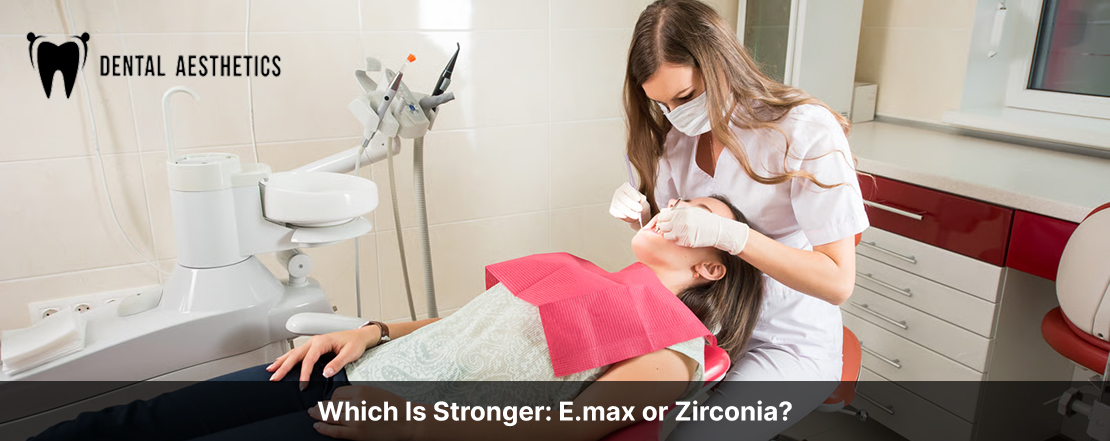
For the products cited by their manufacturers, zirconia typically has a higher flexural strength than lithium disilicate, but strength alone does not determine the suitability of a crown. Ivoclar states that IPS e.max ZirCAD Prime has 1,100 MPa and IPS e.max CAD has 530 MPa.
A clinical crown doesn't experience load in a lab strength test. Its function also relies on crown preparation, thickness, geometry, cementation, occlusion, teeth opposing it and crown manufacturing quality.
Evidence shows both materials are capable of achieving excellent clinical results. A 2025 systematic review on tooth-supported single crowns reported that the estimated five-year survival rates for monolithic lithium disilicate and monolithic densely sintered zirconia were 98.5% and 96.8%, respectively, and for veneered densely sintered zirconia it was 97.3%.
The real question isn't “which material is the strongest?” Rather, “what mechanical demands does this particular tooth place on the restoration?”
Which Looks More Natural: E.max or Zirconia?
E.max can closely reproduce natural teeth since it can be found in different levels of translucency to represent different layers of natural dentin, and in multiple shades.
On the other hand, some zirconia can be manufactured to look natural; however, appearance varies with formulations and whether porcelain is laminated over it.
There are a number of factors that come into play in determining the final look of a restoration aside from the type of ceramic used. Some of these factors include: Shade, contours of the final restoration, finishing of the lab work, the position of the gums, other surrounding teeth, and the type of prep done by the dentist.
IPS e.max CAD is described by Ivoclar as having four levels of translucency with multiple shades, and therefore able to meet the requirements of a clinical case.
In combination with other advanced techniques and recent improvements in zirconia, it has become difficult to reliably say that zirconia restorations will always look opaque.
E.max Crown vs. Zirconia For Front Teeth
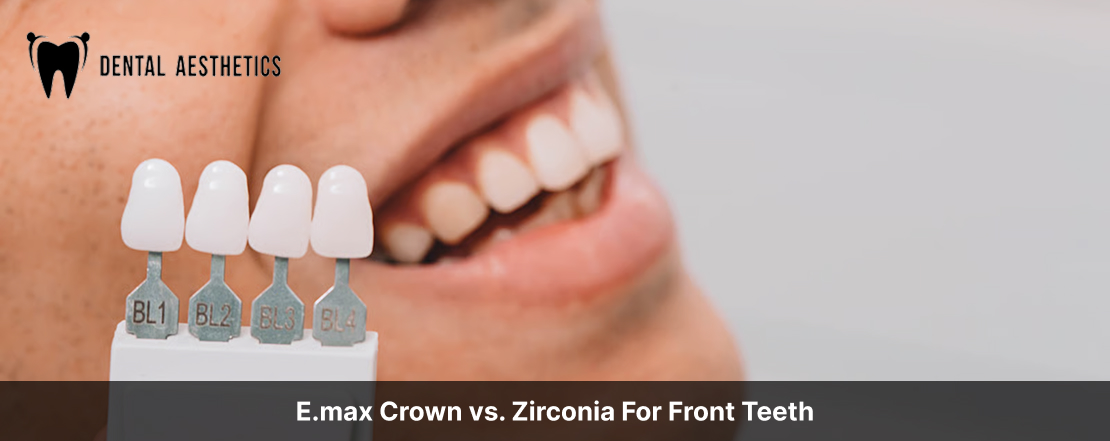
In cases where a front tooth is fully restored, and the clinician can evaluate the optical properties of the material, E.max can be very appropriate. For the same reasons, zirconia can be appropriate for front teeth, depending on the characteristics of the material.
A front tooth with sufficient space, a favorable bite, and high aesthetic demands is a completely different situation from a heavily restored front tooth exposed to strong occlusal forces.
When considering a front tooth, the clinician evaluates:
Translucency: How much light transmits through the tooth
Shade: The color of the surrounding teeth, as well as the color of the tooth being evaluated
Remaining structure: The amount of the natural tooth that is present
Space: The thickness of ceramic that is allowed
Bite: To what degree the tooth comes into contact with the opposing tooth
Tooth position: The alignment and angle of the tooth being evaluated
Grinding: The presence of tooth wear
For patients searching for an E.max crown vs zirconia for front teeth, the practical discussion is therefore about whether the individual tooth benefits more from lithium disilicate's optical characteristics or a suitable zirconia design.
Considering tooth position, existing crown guidance from Dental Aesthetics emphasizes the importance of remaining tooth enamel and dentine, occlusion, available space, and aesthetic requirements, as opposed to automatically selecting a material for a specific tooth.
Zirconia or E.max for Molars and Back Teeth?
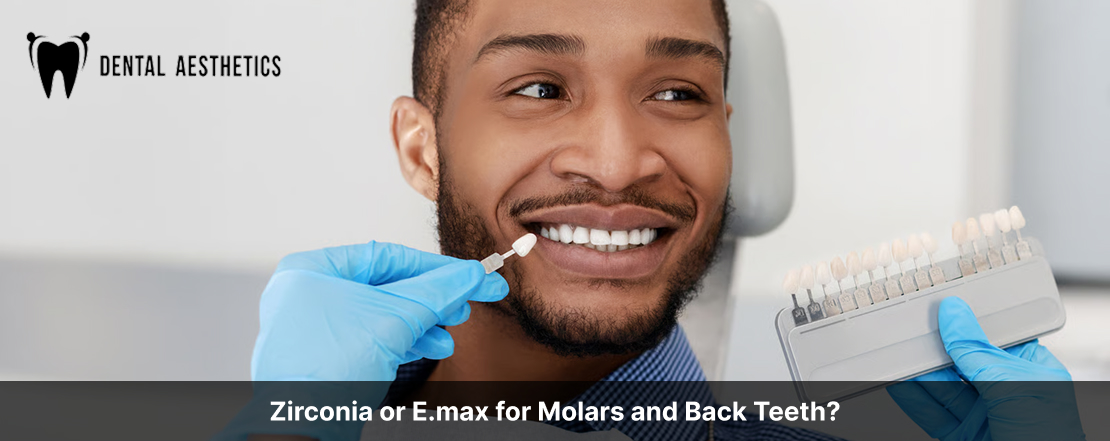
For molars, zirconia can be chosen when high mechanical demands are a primary concern. For the same reason, e.max can also be used for selected posterior crowns, when the specific indication, thickness, and the patient’s bite permit.
The answer should be determined by the nature of the individual restoration rather than by a rigid rule.
In a 2025 systematic review, high five-year survival was reported for both monolithic lithium disilicate and monolithic zirconia tooth-supported crowns. Ivoclar also reported that IPS e.max CAD is indicated for the fabrication of posterior crowns and provided clinical data to support this indication; therefore, lithium disilicate should not always be restricted to the fabrication of anterior crowns.
For a molar, your dentist takes into account:
Thickness of ceramic
Occlusal contacts
Bruxism/clenching
Remaining tooth structure
Opposing teeth
Crown design
Cementation method
Comparing this to a metal-ceramic restoration, Dental Aesthetics also has a PFM vs Zirconia crowns comparison.
Which Crown Is Better If You Grind Your Teeth?
Patients who clench or grind should be assessed to determine if parafunctional forces are impacting the rest of their bite before deciding on the type of crown material. Zirconia is an option for crown material if high mechanical load conditions exist; however, the management of bruxism should not solely depend on the choice of material.
Dental Aesthetics' published bruxism guide states that bruxism can lead to tooth wear as well as breakage and failure of dental restorations. Custom night guards are also described as a protective treatment.
For patients who grind significantly, the dentist should assess the risk from bruxism and decide on the type of crown. Another restoration technique that may be mentioned is the monolithic restoration. Evidence has shown that monolithic designs lead to fewer ceramic fractures and chippings compared to veneered alternatives in some clinical datasets.
That doesn't mean every grinder should automatically get zirconia. Consider the remaining tooth structure, bite, available space, aesthetics, and restoration design.
Patients who grind their teeth can also refer to Dental Aesthetics' article on bruxism treatment in Lahore before their crown consultation.
How Much Do E.max and Zirconia Crowns Cost in Pakistan?
Dental Aesthetics published its 2025 prices for dental prosthetics on its website. It says that the starting price for a zirconia dental crown is PKR 25,000+. Current public pricing does not publish E.max crown prices, so an E.max price should be verified by the clinic, rather than presenting a made-up market price for Pakistan.
Crown Option | Current Published Dental Aesthetics Price |
Zirconia Crown | PKR 25,000+ |
E.max Crown | Not separately published |
This difference is important when looking for emax crown prices in Pakistan or zirconia crown prices in Pakistan. Prices for dental prostheses can vary because different dental labs, designs, and treatment packages can be included in two seemingly identical prices.
Lastly, the final price can depend on the necessity of other procedures, e.g. a buildup, root canal treatment, temporary restoration, imaging, etc., prior to the crown.
Dental Aesthetics' published prosthesis page states its restorative work uses zirconia and PFM for crowns and bridges, and describes digital impressions and CAD/CAM technology in its prosthetic workflow.
How Long Do E.max and Zirconia Crowns Last?
Both E.max and zirconia crowns can provide long-term service, but there is no guaranteed lifespan for an individual patient.
Published evidence shows good medium-term survival for both materials, and the outcome varies based on the following: the design of the crown, location of the tooth, patient factors, and the length of time the patient is followed.
A 2025 systematic review on tooth-supported single crowns found the five-year survival for monolithic lithium disilicate crowns to be 98.5% and monolithic densely sintered zirconia to be 96.8%.
A 2022 systematic review on complete-coverage tooth-retained lithium disilicate restorations found five-year survival to be in the range of 95% to 100%. Ten-year survival was in the range of 71.4% to 100%. The authors reported evidence to support that three-unit bridges had lower survival than single crowns, and variation existed among the studies.
A 2021 summary of systematic reviews on tooth-supported single zirconia crowns reported a five-year cumulative survival to be in the range of 91.2% to 95.9%, which is why a range is more appropriate than quoting a fixed number of years.
These studies do not mean an E.max or zirconia crown will last exactly five or ten years. Other variables, including patient oral hygiene, the risk for decay, periodontal health, bite forces, bruxism, the design of the crown, and how the crown is cemented, will also affect the lifespan of the crown.
Disadvantages of E.max vs Zirconia Crowns
The main disadvantages of E.max are its material strength and indications, while the limitations of zirconia are the differences in translucency and various formulations and the clinical consequences of particular layered designs. No material is appropriate for every tooth.
Disadvantages of E.max Crowns
E.max is not always the ideal solution for every high-load situation. Glass-ceramics, in general, cannot reach the values of high strength and hardness of some specific zirconia formulations. However, E.max is stronger than most all-ceramics.
The restoration needs to be of sufficient thickness and appropriate design
The clinical indication plays a role, especially for bridges and high-load situations
Certain situations require use of adhesive cement and/or isolation
Ruclick status may alter the choice of material and design
In 2019, a systematic review reported that tooth-supported lithium disilicate and zirconia crowns demonstrated similar patterns of survival and complication. However, the quality of evidence varied, and the methods of cementation differed among the studies.
Disadvantages of Zirconia Crowns
Also, zirconia is not one material. Differences in translucency affect appearance, and layered zirconia can incorporate a veneering ceramic, which can chip even if the zirconia framework is intact.
A systematic review of zirconia-based restorations noted that veneering-material fracture was a common technical complication, particularly with older designs of zirconia.
For this reason, the monolithic versus layered zirconia discussion is important when comparing quotes.
How the Dentist Decides: Our Tooth-by-Tooth Guide
Dental Aesthetics' clinical guidance can be considered a case-by-case framework rather than a material rule. The dentist analyzes the tooth's location, remaining structure, bite, space, and a number of other factors, including aesthetics, before determining the material choice.
Situation | Usual Material Discussion | Why |
Upper front tooth | E.max often discussed | Optical properties and translucency |
Lower front tooth | Aesthetic zirconia or E.max | Depends on space and bite |
Premolar | Either, depending on case | Transitional aesthetic and functional zone |
Molar | Zirconia often considered | High chewing forces |
Three-unit bridge | Case-specific | Material indication and connector design matter |
Patient with bruxism | High-strength design considered | Grinding increases mechanical demand |
Heavily stained tooth underneath | More opaque material may be discussed | Masking the underlying shade may be required |
The same applies when a tooth has undergone root canal treatment. Restoration of a structurally deficient tooth may require a crown, but the timing and design depend on the clinical situation. Dental Aesthetics has a separate guide covering same-day crowns after root canal treatment in Pakistan.
Frequently Asked Questions
What is the difference between E.max and zirconia crowns?
E.max is Lithium Disilicate Glass-Ceramic, While Zirconia is Zirconium Dioxide Ceramic. E.max Emphasizes Optical Properties and Translucency, while Zirconia May Provide Higher Mechanical Strength. The Actual Comparison Depends on the Products Being Considered.
Which is better for front teeth, E.max or zirconia?
For selected front teeth, E.max may be considered when translucency and aesthetic integration are priorities. Results with modern high-translucency zirconia can also be aesthetic. Several factors contribute to which option is ideal, including position of the teeth, shade, available space, bite, and the remaining tooth structure.
Which is ideal for back teeth and molars?
When speaking of back molars, zirconia is often the best option when there is a high mechanical demand, but E.max can also be used for selected posterior crowns. The dentist must assess the thickness of the structure, occlusal forces, and the material indication to determine the best option.
How much does E.max cost in comparison to zirconia in Pakistan?
It is not always more expensive. Currently, at Dental Aesthetics, they state that a zirconia crown would start from PKR 25,000 +, and E.max crowns are not published separately. The clinic must provide the current price for E.max for the tooth and material.
In comparison, how long do E.max crowns last?
According to the literature, there are good long-term survival data (5 years) for both lithium disilicate and zirconia crowns. There is no definition for the lifespan of either of the materials. A 2025 systematic review states that the survival of monolithic lithium disilicate single-tooth crowns in a 5-year period was 98.5%, and of monolithic zirconia single-tooth crowns was 96.8%.
What are the disadvantages for E.max crowns?
E.max has a relatively high strength as a glass-ceramic, though there are zirconia formulations with much higher strength values. E.max must also be utilized within proper limits with regard to thickness and design, particularly in areas of high chewing force.
What crown would you recommend for someone who grinds their teeth?
For someone who grinds their teeth (bruxism), it is good practice to assess bruxism and their bite prior to selecting the material for their crown. Bruxism can be managed and the restorations protected with a properly fitted night guard. At Dental Aesthetics, we offer a bruxism assessment and treatment with a night guard.
What is a monolithic zirconia crown?
A monolithic zirconia crown means it is made of zirconia, as opposed to a porcelain veneer being laminated to the surface. Monolithic designs can also reduce the risk of chipping of veneering porcelain compared with some of the layered designs.



Request An Appointment
Map
Timings
Monday - Saturday
11:00 am - 9:30pm
Sunday
12:00pm - 8:00pm