


PFM vs Zirconia Crowns: Preparation, X-Ray, Anterior Teeth, Cost & Strength
September 6, 2026
Selecting the right dental crown isn't just about picking the strongest or most beautiful material. The difference between PFM and zirconia crowns is dependent on the location of the crown, the amount of remaining tooth structure, the bite, the aesthetics wanted, the space availability, and the budget. PFM and zirconia are both proven restorative materials, and the selection of which should be based on a clinical examination and suitable diagnosis.
For patients who are considering PFM vs zirconia crowns in Lahore, an in-person consult can answer questions that an online comparison cannot: do you really need a crown, how much sound structure is left, what does your bite need, what materials are right, and what will the total treatment cost be?
At Dental Aesthetics Lahore, a crown treatment is not one-size-fits-all but is tailored to the specific tooth. The clinic offers restorative and crown services, such as porcelain fused to metal and zirconia, and treatment planning focuses on the functional, aesthetic and longevity aspects.
What are PFM and Zirconia Crowns?
PFM crowns refer to a type of dental crown known as a porcelain-fused-to-metal crown. It is composed of a metal structure to provide support and is topped with tooth coloured porcelain. PFM crowns are very popular in restorative dentistry due to the combination of a strong structure and a somewhat naturalistic outer surface.
Dental zirconia is a ceramic material used to construct a zirconia crown in Lahore. It may be used as a monolithic restoration or in a multi-layered ceramic restoration depending on the type of zirconia system and design. Today, zirconia can be found in various types and formulations, having a variety of optical and mechanical properties.
A dental crown is an inlay that is fixed to a damaged or heavily restored tooth to cover and protect it. Crowns can also be made after root canal treatment if there is not enough remaining tooth structure to provide sufficient protection or as the final restoration on a dental implant.
Feature | PFM Crown | Zirconia Crown |
Basic structure | Metal framework with porcelain | Zirconia ceramic |
Appearance | Tooth coloured porcelain over metal | Tooth coloured ceramic |
Metal substructure | Yes | No |
Aesthetics | Generally good, depending on design | Can give very aesthetic results, depending on the zirconia type |
Strength | Durable when appropriately designed | High strength, depending on formulation and design |
Common considerations | Metal framework and porcelain interface | Zirconia formulation, thickness and optical properties |
Uses | Anterior and posterior teeth | Anterior and posterior teeth |
Cost | Varies by clinic, laboratory and material | Varies by clinic, laboratory and material |
There is clinical evidence that zirconia can be used as a viable material for tooth-supported crowns, but results vary with the clinical situation and follow-up duration. The zirconia-based crowns were found to have generally similar clinical performance to conventional PFM restorations in a systematic review of the literature, and more recent studies have indicated satisfactory results for zirconia restorations.
PFM vs Zirconia Crown: What Is the Main Difference?
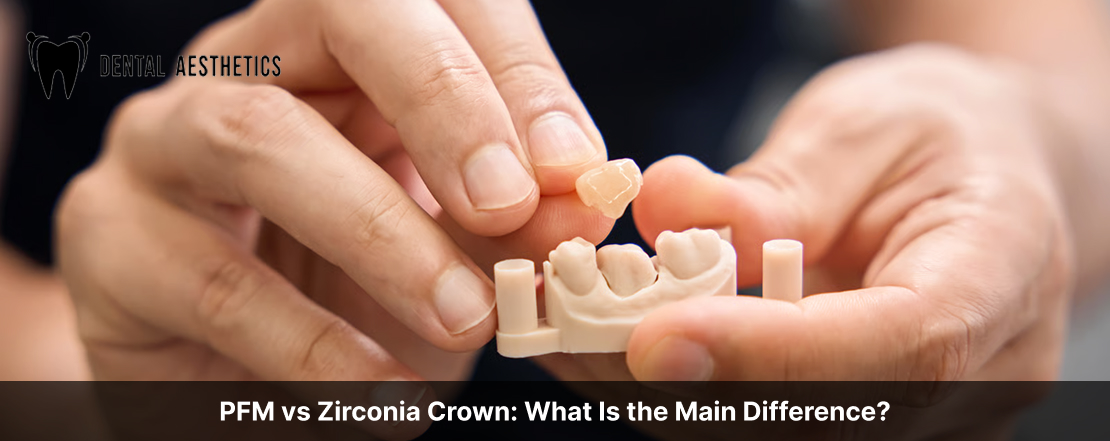
The biggest difference between PFM and zirconia crowns is the material structure. PFM is comprised of two basic components: a metal base structure and an outer porcelain covering. In contrast, zirconia restoration is a ceramic restoration without a metal support. They make a difference in the way the restoration looks, how it passes light, what is considered when preparing the restoration, and how it is designed.
However, material composition is just one of the decisions for the patients.
Factor | What It Means for You |
Aesthetics | The shade, translucency, contour and surrounding gum appearance matter, especially for visible teeth |
Strength | Both materials can offer a long-lasting restoration if they are carefully chosen and planned |
Preparation | The dentist must provide ample space for the chosen crown system and leave as much tooth structure as possible |
Bite | Occlusion and bite force influence material selection and crown design |
Tooth location | Front teeth often place greater emphasis on optical appearance; back teeth experience substantial chewing forces. |
Gumline | A metal-based restoration and an all-ceramic restoration may produce different visual effects around the gingival margin |
The restorative approach of the Dental Aesthetics Lahore clinic takes into account biological, mechanical and aesthetic principles, in which the crowns can be made out of porcelain-fused-to-metal or zirconia/milled.
PFM vs Zirconia Crown Preparation
Rather, the amount of tooth reduction should not be a set number of millimetres in diameter. The amount of tooth reduction should not be a fixed number of millimetres in diameter; PFM should determine it vs zirconia crown preparation. The preparation of the crown is tooth-specific and is dependent upon the crown system, material, lab design, occlusion, existing tooth structure and the clearance required.
First, the dentist evaluates the tooth and decides whether a full crown is needed. If it is, it is carefully contoured to allow space and geometry for the restoration. The goal is to retain adequate thickness of tooth structure and to not remove healthy tooth structure.
In PFM, the preparation should be designed in a way that allows for the metal framework and porcelain to fit together. The clearance requirements for zirconia preparations differ and depend on the type of zirconia preparation and the nature of the crown design.
The dentist might also check:
Enamel and dentine that are left
Filling(s) or old restoration(s)
The tooth's position
The occlusion and opposing teeth
Available interocclusal space
Crown margin location
Aesthetic requirements
If the tooth has been root canal treated or not
The preparation is therefore a compromise between the retention, resistance, thickness of material to be removed and the preservation of tooth structure. The claim for the patient is too general, when it should be "zirconia always needs less preparation" or “PFM always requires more tooth reduction.” The specific preparations will vary with the type of restoration and the specific tooth being restored.
An accurate evaluation of the crown by Dental Aesthetics Lahore may be helpful in deciding if a crown is needed, what preparation is suitable and what material may be used. The use of digital techniques for prosthetic treatment and CAD/CAM fabrication is also discussed.
PFM vs Zirconia Crown X-Ray: What Can You See?
One of the reasons for patients looking up PFM vs zirconia crown X-ray info is to find out if a crown will show up on a dentist's X-ray. The answer will vary based on materials and restoration design. Dental X-rays do not just indicate if the crown is “good” or “bad.” However, radiographs are not always used for diagnosis, but rather are a component of a broader diagnostic process.
Dentists might also take a dental X-ray before crown treatment to determine the condition of the tooth and its surrounding structures. The dentist might seek problems like decay, changes around an existing restoration, condition of a root canal-treated tooth, bone levels or other findings that can't be evaluated completely clinically.
After treatment, radiographs may sometimes be used when there is a clinical reason to evaluate the tooth or surrounding structures.
X-Ray Factors | Why It's Important |
Existing decay | Aids in assessing areas that may not be visible to the naked eye |
Root and surrounding bone | Important in evaluating a tooth before or after restorative care |
Root canal treatment | Radiographs may aid in the evaluation of the treated tooth and surrounding tissues |
Crown margins | The dentist considers the relationship of the restoration to the tooth and surrounding structures |
Material visibility | The radiographic appearance of various crown materials and designs may vary |
Symptoms | Pain, swelling or other concerns may require further imaging |
The important thing is that the X-ray appearance of PFM vs. zirconia crown should be interpreted by a dentist together with clinical findings. A crown cannot be determined to be esthetic, comfortable or well-designed by an X-ray alone.
If your dentist recommends an X-ray before a crown, it is most often because the diagnostic information is important enough to influence treatment planning, not because the material can be viewed with an X-ray alone.
PFM vs Zirconia Crown for Anterior Teeth
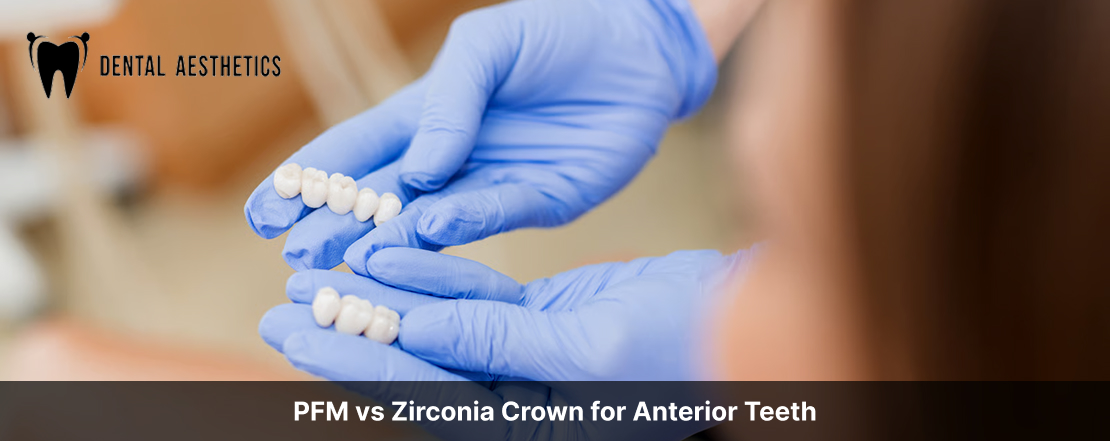
This comparison becomes especially significant when talking about PFM versus zirconia crown anterior restorations. Anterior teeth are highly visible, and esthetics may have a greater role in the selection of material. Patients might be concerned about the color, translucency, contour and symmetry and how the crown looks in different lighting conditions.
PFM can create a natural result; however, the metal substructure can affect the way light interacts with the restoration. In some cases, patients can have concerns about the appearance of the gumline as well, especially if the restoration design or gingival changes reveal the underlying metal.
Zirconia lacks a metallic substructure, and different formulations can be chosen to provide varying degrees of strength and translucency. But “zirconia” is not a single material with identical optical properties. The final appearance is dependent on the actual zirconia system, thickness, shade, staining, finishing and laboratory technique.
Anterior Consideration | PFM | Zirconia |
Tooth color transparency | Yes | Yes |
Metal-free | No | Yes |
Translucency | Design-dependent and porcelain-dependent | Design-dependent and zirconia dependent |
Appearance of the gumline | May need meticulous aesthetic planning | No metal framework |
Shade matching | Highly customizable | Highly customizable |
Functional durability | Option established | Option established ceramic |
Suitability | Case-by-case | Case-by-case |
Your dentist may also consider adjacent teeth, facial features, lip position, gum contour and the shade you desire for a visible front tooth. A crown should not look like a single artificial tooth alone; it should be planned for harmony with the surrounding smile.
This may be particularly important for the patient who is contemplating multiple anterior crowns or a wider smile makeover, as opposed to just one isolated restoration.
PFM vs Zirconia Crown Cost in Pakistan
One of the most common concerns patients have when researching crown treatment in Pakistan is the PFM vs zirconia crown cost question. Neither material carries a single universal price. The end cost will be affected by:
Material of product/system and crown-specific
Dental laboratory and manufacturing process
Tooth position
Preparation complexity
If additional treatment is needed
Digital scanning or CAD CAM process
Temporary obligations to rehabilitate
Dental practice and clinic
Number of crowns being fitted
Location within Pakistan
A crown quotation should therefore be regarded as part of a complete treatment plan rather than the cost of a piece of material. For instance, a tooth may require a filling, core build-up or root canal treatment prior to having the crown placed. Sometimes you may also need gum treatment. Comparing two crown prices in this way overlooks these factors and can give a misleading impression of the overall cost of treatment.
Permanent crowns are created in a clinical laboratory, although zirconia or milled crowns can be digitally manufactured in an appropriate clinic or laboratory workflow. It offers restorative care including crowns and root canal treatment.
The clinic also claims to provide zirconia and PFM crowns and digital impressions and CAD/CAM systems for prosthetic treatment. The best way to get an accurate PFM vs zirconia crown cost in Pakistan is to have the tooth examined and ask for a treatment plan that details the crown material, lab or digital workflow, any preliminary treatment and what is included in the quoted fee.
PFM vs Zirconia Crown Strength
When comparing PFM vs zirconia crown strength, it is important to distinguish between laboratory strength and clinical durability.
Zirconia is a high-strength ceramic, but zirconia crowns are available in different formulations. Some are better optimized for strength; others are designed to give more translucency. Restoration thickness, shape, surface treatment, cementation and occlusion can also affect performance.
PFM crowns have a long clinical history. The metal framework gives structural support, and the porcelain gives the visible tooth colored surface. However, the porcelain coating may be subject to chipping or fracture under certain conditions.
Modern zirconia restorations have also shown encouraging clinical success. Systematic reviews of monolithic CAD/CAM zirconia crowns have reported survival rates from 91% to 100% in the short-term studies included, but the researchers noted considerable variation between studies.
More recently, a systematic review of zirconia dental restorations found generally acceptable short- to long-term survival, but noted that results vary by restoration type, and biological and mechanical complications are still possible. The meaning and tone of the following text in English will be humanized. No information will be added or omitted. No other text will be added to the output.
Material formulation: Mechanical and optical properties of zirconia types differ.
Crown thickness: Insufficient or wrong thickness can impact performance.
Crown design: Stress distribution is affected by shape and internal geometry.
Occlusion: Mechanical demands may be increased by heavy occlusal forces
Bruxism: The grinding or clenching may increase the stress on restorations.
Cementation: The success of the treatment in the clinic depends on proper bonding or cementation.
Laboratory quality: Accurate digital or conventional fabrication affects fit and function.
Thus, the comparison of the strength of PFM and zirconia crowns cannot be simplified to a competition between two labels. Restoration design is more meaningful when it is well-matched to the patient's tooth and bite, rather than simply based on a strength claim for the material.
The Best Clinic in Lahore, Pakistan for PFM or Zirconia Crowns
If you’re still confused about PFM vs zirconia crowns, the next step shouldn’t be to pick a material based on an internet comparison. A dentist needs to see the tooth, evaluate your bite, the surrounding tissues, any necessary dental X-rays, and determine how much healthy tooth structure remains.
Dental Aesthetics Lahore offers restorative care, crowns and bridge treatment in Lahore and prosthetic solutions. The published information states that PFM and zirconia crown options are available. As part of its treatment approach, the clinic also describes digital scanning, CAD/CAM technology and specialist prosthetic care.
If you are a patient in Lahore considering a crown for a damaged, discolored, root-canal-treated or heavily restored tooth, a consultation with expert dental professionals like the ones at Dental Aesthetics can give you a personalized comparison of PFM vs zirconia crowns, including preparation, esthetics, strength and the anticipated treatment cost. It’s not just about picking the latest material. It is about selecting a restoration that is right for your tooth, your bite, your smile and your long-term oral health.
Reach out to Dental Aesthetics Lahore and book a crown consultation to have your tooth evaluated and discuss whether PFM, zirconia or some other restoration is suited to your particular needs.
PFM vs Zirconia: Which One Is Better?
So, who is the winner of the battle between PFM and zirconia crowns? Instead, think of what is most important in your own case. For a highly visible anterior tooth, esthetic factors such as translucency, shade, appearance of the gumline and the surrounding smile may be more important. For a posterior tooth, chewing forces, available space, occlusion and functional durability may be more important.
The amount of tooth structure that remains is also important. The dentist must determine if the tooth is restorable to a predictable crown, and if further restorative treatment is indicated. Budget is another valid consideration. When both materials are clinically appropriate, the difference in cost, laboratory workflow and esthetic objectives can be part of the decision.
Patients can discuss their options for crowns as part of a broader restorative assessment at Dental Aesthetics Lahore. Clinic published restorative-care information describes treatment planning around esthetics, function and longevity and lists both PFM and zirconia/milled crown options.
Frequently Asked Questions
Is zirconia stronger than PFM crowns?
Zirconia can have very high mechanical strength, but clinical performance is dependent on the zirconia formulation, crown design, thickness, occlusion, cementation and patient factors. PFM crowns are also proven to be long-lasting restorations. Strength alone should not be the choice.
PFM vs Zirconia: Which is Better for Your Front Teeth?
Both can be used for the front teeth. The decision may be based on translucency, shade, gumline appearance, remaining tooth structure, and functional requirements. Zirconia does not use a metal substructure, and PFM is still a valid option if it is well designed.
Is more tooth preparation required for zirconia than PFM?
Not everywhere. PFM vs zirconia crown prep depends on the material system, design of the restoration, tooth and available space. There is not one reduction rule for all cases. Your dentist should determine the proper preparation.
Can PFM and zirconia crowns be differentiated on X-ray?
These are different materials and designs and may therefore have different radiographic appearances. However, a PFM vs zirconia crown X-ray should be interpreted by a dentist along with a clinical exam. X-rays are diagnostic tools, not a simple test of crown quality.
In Pakistan, are zirconia crowns more expensive than PFM crowns?
They can, but there is no standard price difference. The cost of a PFM crown versus a zirconia crown is determined by material/system, dental laboratory, digital workflow, tooth, case complexity and clinic. Getting a quote specific to you is better than using a general Pakistan-wide price.
How long do PFM and Zirconia crowns last?
Both can give long term service if planned, manufactured, fitted and maintained correctly. Longevity varies from patient to patient and depends on oral hygiene, caries risk, periodontal health, bite forces and bruxism and crown design, amongst other things. Clinical studies have shown zirconia to be a viable long-term restorative material. However, no crown should be considered permanent or guaranteed to last a certain number of years.
Which of the crowns looks more natural?
There are no universal answers. Translucency, shade, contour, surface texture, surrounding teeth and skill of the dental team influence the natural appearance. Modern zirconia can give very esthetic results, but well-made PFM restorations can also be natural-looking. Esthetic planning is particularly important for anterior teeth.
Can I use PFM or zirconia for front and back teeth?
Yes. Both materials can be used in different clinical situations of anterior and posterior teeth. The correct choice depends on the tooth, the bite, esthetics, available space, restoration design and clinical requirements.



Request An Appointment
Map
Timings
Monday - Saturday
11:00 am - 9:30pm
Sunday
12:00pm - 8:00pm