


Veneers vs Lumineers: What's the Difference
November 10, 2026
Lumineers is a specific type of veneer from a specific brand and laser-engineered to be ultra-thin and minimally prepared, whereas veneer” is the general term that encompasses traditional porcelain veneers, as well as a few other types.
When you're thinking about veneers vs. Lumineers, it's essential to understand that they aren't two distinct forms of dental care. Both are thin restorations that are applied on the visible surface of teeth to enhance the colour, shape, proportions or minor imperfections. Importantly,
Patients in Lahore are asked to consider three questions when deciding between veneers and Lumineers: How much correction do teeth need? How much natural enamel should be preserved? What type of aesthetic outcome is desired? In cases where there is extensive discoloration, uneven tooth shape, gaps, or alignment issues that require correction, traditional porcelain veneers offer greater control. Minimal preparation or even no preparation could be appropriate if the teeth are already well seated and only relatively minor adjustments are needed.
Veneer treatment is not just about selecting a veneer product because it's labeled as “no-prep” or “more natural”; it's about understanding the specific smile of the patient and crafting a treatment plan that matches it. The Dental Aesthetics clinic provides porcelain, ceramic, composite and Durathin veneers and treatment is planned following consultation.
Is Lumineers a Type of Veneer? Understanding the Difference Between Veneers and Lumineers
Yes, lumineers is not a stand-alone option to dental veneers, but part of the larger group of dental veneers. Lumineers are a type of veneer made by a specific brand, veneer refers to the broader category of restorations that involve covering over the front of a tooth.
This is important as “Lumineers” is used online as if it were all thin or no-prep veneers. This is not the case. Not all of the no-prep veneers or minimal-prep veneers are Lumineers branded veneers. The differences between veneers and lumineers are more of an old-school vs. ultra-thin, minimal prep or no prep veneer situation.
An ordinary veneer is a personalized ceramic restoration that is bonded to the front of the tooth. It can alter the colour, shape, width and “look” of the tooth. For a more complete description of what dental veneers are and how they function, check out our dental veneers guide – what dental veneers are and how they work. It's not only the brand. This is the level of preparation your teeth must go through to get the desired outcome.
Do Lumineers Require Enamel Removal? The Real Difference in Tooth Preparation
The primary difference between a traditional veneers treatment and the no-prep lumineers is the amount of tooth preparation that is needed. Typically, traditional porcelain veneers involve grinding away a thin layer of enamel to allow for the installation of the porcelain veneer, whereas no-prep or minimal-prep veneers are designed to preserve more of the natural tooth.
The hard outer part of a tooth is called enamel. Enamel cannot repair itself once it has been lost, unlike other tissues in the body. That is the reason why preparation is one of the most vital topics to oversee prior to cosmetic therapy.
This will depend on the tooth, the ceramic, the desired color, the shape, and the treatment plan. Typical restorations may require about 0.3 to 1.0 mm of reduction, and ultra-thin restorations will be significantly less prepared.
No-prep does not necessarily mean “absolutely nothing is touched.” In some instances, however, a little enamel conditioning/modification may still be necessary to achieve appropriate contours, margins and bonding.
Preparation factor | Traditional porcelain veneers | Lumineers / no-prep approach |
Enamel removal | Some enamel is generally removed | Little or none, in suitable cases |
Purpose of preparation | Creates space and controls shape, fit and colour | Preserves tooth structure where anatomy permits |
Thickness | Generally higher restorative thickness is available | Ultra-thin design |
Masking ability | More flexibility for significant colour changes | More dependent on original tooth colour |
Reversible | Not reversible if enamel is removed | Reversible, but not completely in every instance |
There is more and more evidence to support enamel preservation when clinically feasible. A recent review highlights that minimally prepared veneers can be successful in carefully selected cases, especially if placed onto sound enamel, and that conventional veneers can be successful for more complex aesthetic corrections.
Veneers vs Lumineers at a Glance
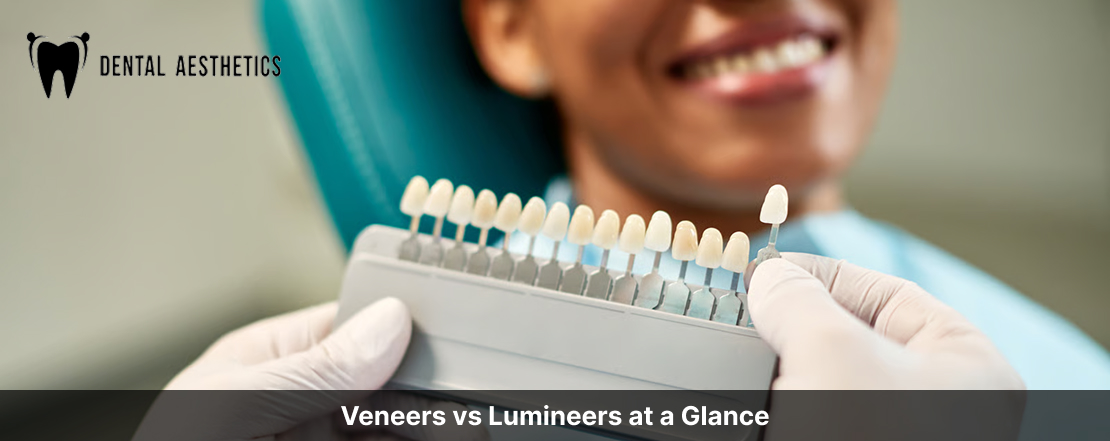
It is important to understand that Veneers vs Lumineers is not two distinct treatments, but rather a comparison of treatment options. Traditional prepared porcelain veneers offer more control for significant changes, while ultra-thin strategies emphasize the conservation of tooth structure in appropriate cases.
Factor | Traditional prepared porcelain veneers | Lumineers / no-prep veneers |
Primary function | Correction of colour, shape, size and aesthetics | Conservation of aesthetics |
Tooth preparation | Enamel reduced (usually) | Little or no enamel reduction (selected cases) |
Reversibility | Generally not reversible | Relatively more reversible, depending on preparation |
Discolouration | Better suited to significant staining | Better suited to lighter starting shades |
Alignment | Can compensate for some visible irregularities | Best if teeth are reasonably aligned |
Shape changes | Greater freedom to reshape | More limited by existing tooth contours |
Translucency | Can be adjusted to offset the masking and the natural appearance | More dependence on the underlying tooth colour |
Candidate selection | Broad, including complex cosmetic cases | More selective |
Cost | Depends on material, number and complexity | Depends on brand, laboratory and case |
Main disadvantage | Greater aesthetic and restorative control | Greater preservation of natural tooth structure |
What is important to remember is that a thin veneer isn't necessarily a good veneer. If it is not thick enough to correct for the amount of correction, a restoration that is too thin may reveal the underlying shade or result in an undesirable contour.
Which Looks More Natural: Veneers or Lumineers?
Both are not always the most natural looking; the most natural outcome depends on the starting teeth, material, shade and treatment design and translucency. Translucency is defined as the passage of light through a material, not just reflection off of it. The natural enamel possesses a special optical quality, which is reproduced in ceramic restorations.
The amount of opacity control in traditional porcelain veneers is more than what is possible with composite ones. This can be significant in the case of significant staining of teeth or if the patient wishes for a major colour change.
Porcelain veneers are custom-made restorations that are created around the specific tooth and smile using porcelain, which can be used to replicate the look of a natural tooth, as the clinic, Dental Aesthetics, describes them.
Aesthetic concern | More suitable approach to discuss |
Mild shade irregularity | Minimal-prep/no-prep may be considered |
Significant intrinsic staining | Traditional prepared porcelain may provide better masking |
Small chips | Either may be considered depending on tooth structure |
Major shape correction | Traditional preparation generally provides greater control |
Mild spacing | Either may be considered after assessment |
Already well-shaped teeth | Minimal-prep approach may be suitable |
How Long Do Lumineers Last? Veneers vs Lumineers Lifespan and Durability
There is no warranty on the life of either option, as longevity is dependent on bonding, enamel preservation, bite forces, condition of teeth, material, oral hygiene and grinding or other habits.
That's why statements like “Lumineers last X years” or “traditional veneers last longer” are too simple. The research has proven that it is important to bond the ceramic veneers to sound enamel. A 2024 systematic review and meta-analysis revealed that the type of substrate to which the ceramic veneer is cemented has a significant impact on clinical survival and on the rate of complications, which is why it is important to preserve a suitable substrate whenever possible.
In 2025, the results of a systematic review of RCTs were also found to be promising for no-prep veneers. The evidence base was, however, limited to four eligible studies with 126 patients and 612 veneers, so these results cannot be blindly assumed for every patient. The most logical approach to looking at the durability of Lumineers is not “How many years are guaranteed?” but “How well does this restoration fit my teeth, bite and treatment objectives?”
Poor oral hygiene, hard object chewing, nail biting and grinding can all impact the long-term performance of cosmetic restorations.
Who Is a Good Candidate for Lumineers and Traditional Veneers?
Whilst traditional veneers may be more appropriate in patients who need more colour, shape or positioning adjustment, no-prep veneers or Lumineers are usually appropriate for patients who have carefully selected teeth and only a very limited amount of aesthetic adjustments to make.
Your dentist will examine your enamel, where your tooth is located, your bite, your gums, any existing restorations, the colour of your teeth and the desired outcome before offering a recommendation.
Patient situation | Treatment discussion |
Teeth are well positioned | Minimal-prep may be considered |
Mild cosmetic imperfections | Either approach can be considered |
Significant intrinsic discoloration | Traditional porcelain may offer better masking |
Noticeable crowding | Orthodontic treatment may need consideration before veneers |
Large shape changes required | Traditional veneers may provide greater control |
Satisfied with maintaining enamel | Minimal-prep/no-prep approach may be considered |
Presence of any dental disease | Dental health should be addressed prior to cosmetic treatment |
This is where options are also important. If you are more concerned about teeth color than their shape, you might want to consider professional whitening before you decide to get veneers. In some instances, composite bonding can be a more conservative treatment, if a small shape correction is needed.
Dental Aesthetics provides cosmetic dentistry solutions that can range from very simple, like bonding and whitening, to veneers and other more advanced restorative therapies.
What Is the Procedure Like for Veneers vs Lumineers?
A smile design consultation and appropriate treatment planning are typically the first steps for both treatments, but a smile with traditional veneers would need to be prepared for the cement, while a Lumineers or no-prep smile might involve only enough enamel removal to achieve a proper fit, and avoid preparation.
Typically, the first step in the process is determining your smile analysis, teeth, bite and expectations. These impressions or digital scans can then be used to plan and make the restorations.
Treatment stage | Traditional veneers | Lumineers/minimal-prep |
Consultation | Yes | Yes |
Satisfied smile design | Yes | Yes |
Scan/impressions | Usually | Usually |
Tooth preparation | Typically required | Minimal or none in suitable cases |
Try-in/fitting | Yes | Yes |
Bonding | Yes | Yes |
Cementation | Yes | No |
Number of visits | Depends on case and laboratory | Depends on case and laboratory |
It's a good idea to be aware that marketing claims that no-prep veneers are always much faster may not be entirely true. But it doesn't mean that every patient will go through all steps of the smile makeover in a single appointment. The fewer steps that are taken, the fewer appointments it doesn't mean that every patient will go through all steps in a single appointment.
The current Dental Aesthetics porcelain veneer workflow encompasses consultation and smile design, preparation, digital impressions, lab work, fitting and bonding.
Veneers vs Lumineers Cost in Lahore, Pakistan
The price of veneers vs. lumineers in Lahore varies based on the material or brand used, the number of teeth to be veneered, laboratory work, treatment plan and complexity. Quotations can only be done after an individual consultation.
Porcelain veneers are currently being sold in an estimated price range of PKR 30,000-60,000 per tooth in Lahore, depending on the material, clinical requirements, and number of teeth. The clinic does not have a fixed price for Lumineers listed on the veneer service page, and making up a price may be misleading. The actual cost of the branded ultra-thin product may be different, but the cost quotation should be in accordance with the specific case.
Cost factor | Why it affects your quotation |
Number of teeth | More veneers increase the overall treatment cost |
Material | Ceramic, porcelain, composite and specialised products differ |
Brand | Branded products may involve additional laboratory/licensing costs |
Tooth preparation | Complexity of preparation affects clinical time |
Smile design | Detailed planning and digital workflows can impact treatment |
Existing dental work | Old fillings, decay or other problems may need to be addressed |
Replacement treatment | Replacing existing veneers is different from first-time treatment |
When looking at veneers vs. Lumineers cost, don't compare two veneer prices to tooth prices without asking the question: what is included? The restoration work, lab work, consultation, scans, fitting and follow-up should be explained in your quotation.
To know about traditional porcelain veneer prices and advantages, read our guide on porcelain veneers in Lahore.
Are Lumineers Reversible? Can Lumineers Be Removed or Replaced?
While it's possible that Lumineers may leave behind more natural enamel in relation to other dental options, the term ‘reversible’ does not simply mean that every case can be returned to its original state. In most cases, the enamel must be removed in order to be able to use traditional veneers. After this enamel is gone, it never comes back, and the tooth will probably need some sort of restoration.
The upside to no prep or minimal prep is that the structure remains more natural. But the specific procedure that was carried out was important. Enamel modification or other preparation may be done even if conditioning is performed.
Can You Switch From Lumineers to Traditional Veneers Later?
Later, a patient may be able to transition from a Lumineers or no-prep restoration to traditional veneers, but this depends on the condition of the existing restorations and the teeth. The dentist might be forced to remove the old filling, re-evaluate the enamel and the position of the tooth, and then decide if further preparation is necessary.
This is one reason why the Treatment Plan is important. Just because an ultra-thin option is more conservative doesn't necessarily mean it is appropriate if the desired effect is a significant amount of masking or reshaping.
The focus at Dental Aesthetics is to understand the patient's smile and choose the correct veneer type instead of using the same veneer type for all patients. Currently, the clinic provides a range of veneer options like Durathin, ceramic, porcelain and composite veneers.
Veneers vs Lumineers Pros and Cons
Traditional veneers offer more control over colour and shape, and Lumineers/No-prep approaches offer more protection of natural tooth structure in the appropriate cases.
Option | Main advantages |
Porcelain veneers | Good aesthetic control, suitable for large shade and shape changes, typically requires enamel preparation for use in typical cases |
Lumineers/no-prep | Preserves more enamel in selected cases |
Composite veneers | Often less expensive, can be less-prepared, and can stain and chip |
Whitening | Conservative choice for colour issues |
In addition, Dental Aesthetics provides composite veneers. which, according to the clinic, are a cost-effective alternative that, in many cases, are prepared less, but may be more prone to staining, chipping and breakage than porcelain.
Which Is Better, Veneers or Lumineers?
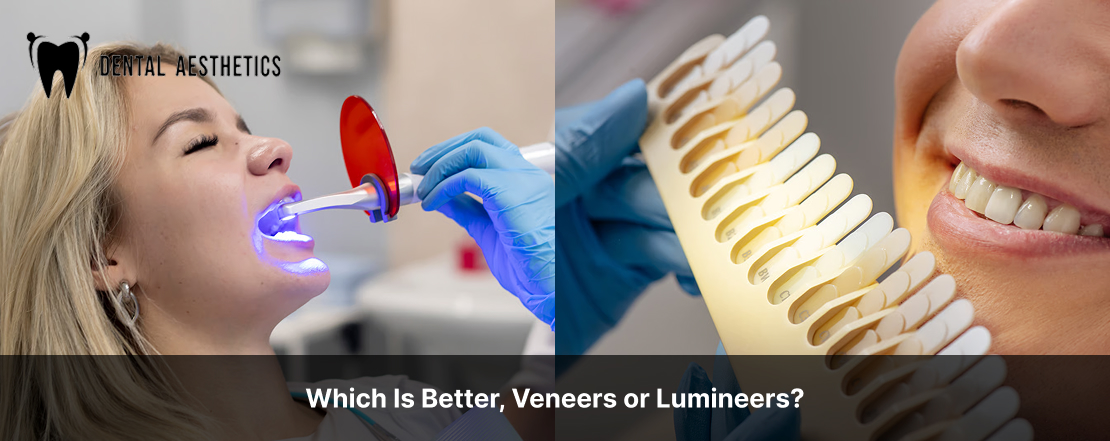
Both are not bad; traditional veneers might work better if you need more extensive cosmetic correction, while Lumineers or another minimal-prep solution might work better if you don't want to damage your teeth and have a tooth that is good.
There are four questions that are helpful to ask when making a decision:
1. What colour change are you looking for?
2. What is the amount of change required for the shape of the tooth?
3. Do you already have your teeth in correct alignment?
4. What is the importance of maximum preservation of natural enamel?
For more dramatic shade change, a traditional porcelain veneer might offer better predictability for heavily stained teeth. If you have fairly good alignment and shape to your teeth and just want the tiniest change, you might consider a minimal prep. This should be based on clinical assessment rather than following any of the options that seem less invasive via the internet.
The Best Veneers and Lumineers in Lahore, Pakistan
The first step that Dental Aesthetics Lahore takes in a veneer treatment plan is to assess your personal smile. The clinic offers cosmetic dentistry in Lahore, which includes veneer treatments such as porcelain veneers, ceramic veneers, composite veneers, and Durathin veneers. The cosmetic dentistry service of the clinic emphasizes the importance of treatment planning based on each patient's unique appearance and smile objectives, while the veneer service emphasizes the personalization of veneers and various material options.
Dr. Shahzad Mirza is a BDS dentist having MSc in Aesthetic Dentistry from the UK, and his professional profile mentions an MSc in Advanced Aesthetic & Restorative Dentistry from King's College London.
The next best course of action if you're considering veneers vs. Lumineers is not to select a product before visiting a dentist. Schedule a smile consultation to evaluate your enamel, positioning, colour, bite and desired result, and to discuss which veneer is the best fit for you.
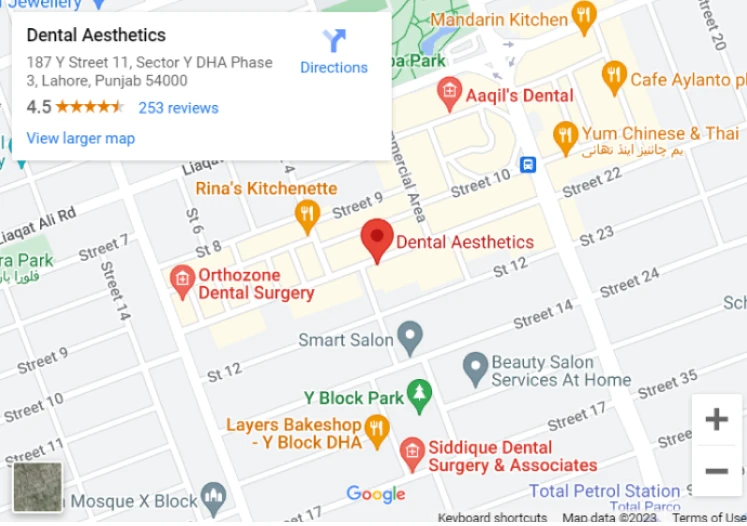
Visit Dental Aesthetics' office in Lahore or call the dental office to schedule an appointment. Currently, the clinic has locations in DHA Phase 3, DHA Raya Phase 6 and Gold Crest Mall, DHA Phase 4.
Conclusion
A decision between Veneers and Lumineers is not just a matter of two competitors, as Lumineers is a brand name for a particular veneer, whereas regular porcelain veneers refer to an earlier method of application, normally involving some enamel work.
In case you need dramatic changes in color, shape, or aesthetics of your smile, it might be worth getting more information on porcelain veneers. If your teeth are aligned and you would like to minimize your loss of enamel, having a reduction or no-prep treatment may become a viable option.
What matters here is your teeth, not the name of the product. For those who contemplate improvement of their smile in Lahore, Dental Aesthetics offers options for veneers along with individualized cosmetic treatment plans
Frequently Asked Questions
Is Lumineers just a brand name for veneers?
Lumineers is a specific and distinct product of veneers that is not used as a generic term for all no-prep veneers. Other manufacturers' no-prep or minimal-prep veneers should not be called Lumineers.
Is there any enamel to be removed for Lumineers?
Not necessarily. Other no-prep options like lumineers aim to maintain the enamel, although in some instances, it may be necessary to condition or prepare the enamel. Your dentist will discuss in detail what modifications will be made before the treatment.
Are Lumineers more expensive than regular veneers?
Not necessarily. Price is determined by the product, laboratory, the number of teeth and complexity. At the time of consultation, the price for porcelain veneers is PKR 30000 – 60000 per tooth for dental aesthetics and will be confirmed separately for Lumineers.
Is there a possibility of changing from Lumineers to regular veneers at a later time?
Potentially, yes. Feasibility will depend on the condition of the teeth and the existing restorations. While some preexisting structures can be removed without further evaluation or preparation, other types of teeth may not be able to accept a veneer the first time.
Can veneers or Lumineers be stained?
The ceramic veneers are not prone to numerous types of surface staining; however, the surrounding natural teeth may discolor. Oral hygiene and routine dental examinations help to ensure a uniform and attractive look.
How many times does each one make a visit?
Consultation, smile design, digital scans or impressions, fabrication, fitting and bonding are all possible options for both approaches. Although with no prep the treatment may bypass some or all preparation steps, this does not imply that the entire treatment is delivered in a single appointment.
Can you get both types in the same mouth?
There may be instances where different restorative responses can be utilised in different areas; this should be thoughtfully considered. Coordinated shade, translucency, shape and bite are necessary for consistent-looking restorations.
Which lasts longer, veneers or Lumineers?
No one is guaranteed a winner. Longevity is determined by material, bonding, enamel maintenance, bite forces, oral hygiene and habits (grinding). When used and maintained correctly, both methods have been proven to be effective in clinical studies.



Request An Appointment
Map
Timings
Monday - Saturday
11:00 am - 9:30pm
Sunday
12:00pm - 8:00pm