


Stages of Tooth Decay: From White Spots to Abscess, and the Treatment and Cost at Each Stage
November 13, 2026
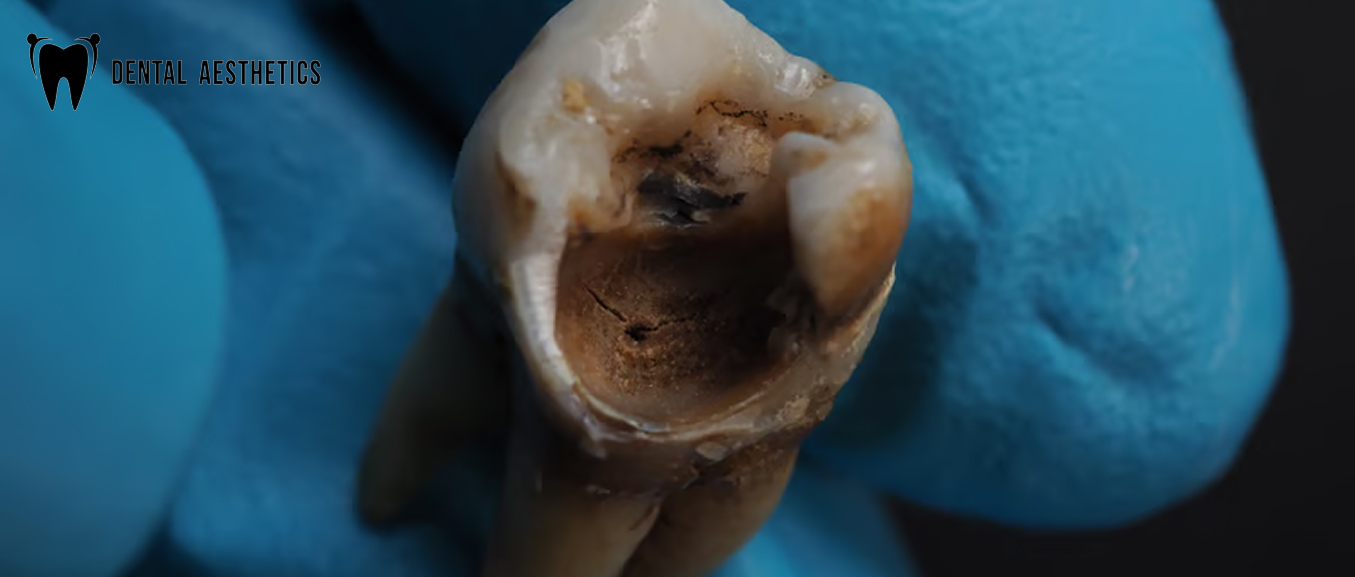
Tooth decay (دانتوں کا کیڑا) occurs when mouth bacteria produce acid that slowly damages a tooth. The stages of decay range from early, reversible stages to later, irreversible stages. White spots are an early stage of decay. These may be reversed with the use of fluoride. Later, irreversible stages of decay may include damage to the tooth's pulp and/or an abscess. During the later stages of tooth decay, a physical hole cannot heal itself. An examination at Dental Aesthetics Lahore may identify damage caused by tooth decay and determine the appropriate treatment.
Early loss of tooth enamel minerals may be reversed if treated in time before a cavity forms. Once the loss of tooth structure becomes irreversible, a filling, root canal, or crown becomes necessary. Being able to recognize the various stages of tooth decay can help patients make the best decision for their treatment and understand the factors that affect the cost of dental care in Pakistan. At Dental Aesthetics Lahore, a check-up can help rule out any abnormalities, explain treatment options, and help alleviate any discomfort caused by an undiagnosed tooth condition.
Dental Aesthetics Lahore offers a professional assessment for patients with cavities, sensitivity and other restorative dental concerns. The dental team evaluates the affected tooth and explains the possible treatment options and a cost estimate. A dental consultation is recommended if a patient notices a white or dark spot on the tooth or experiences a toothache. The consultation will help identify the problem at an early stage. Dental Aesthetics Lahore offers different services related to restorative dental care. To know more and to get yourself assessed, contact them now.
What are the Stages of Tooth Decay?
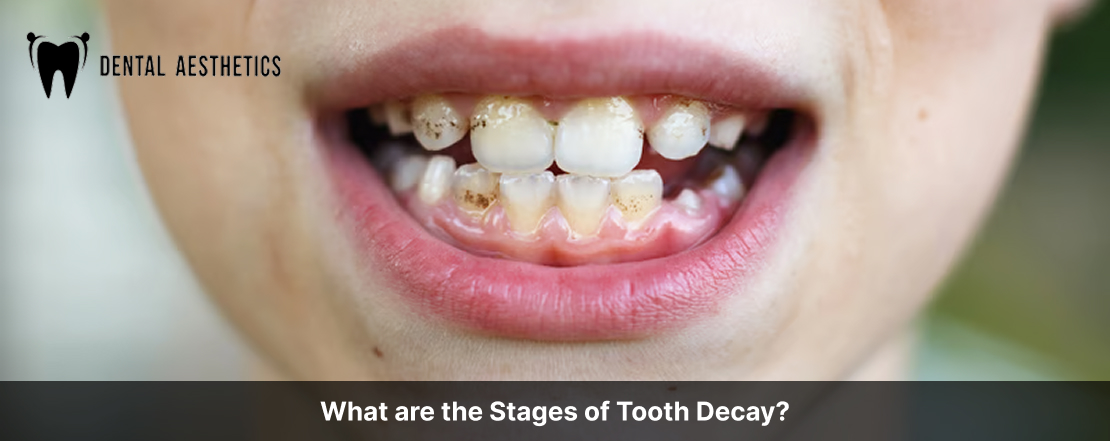
Tooth decay occurs in five stages described as loss of mineral from enamel, progressing to deeper layers of the tooth. This may also result in an infection of the tooth’s pulp and an abscess. This article provides a clinical description of each stage based on the NIDCR. It ends with complications that may occur due to lack of treatment for the infected tooth. Cavities may be reversible before they cause a loss of mineral in enamel; however, NIDCR advises that once a cavity forms, it requires dental treatment.
Decalcification: Loss of some of the mineral content of the tooth's enamel.
Cavitation: Decay has progressed through the enamel into the dentin, causing a cavity.
Pulp Infection: Decay has advanced to the core of the tooth.
Abscess Formation: Pus has collected in the jaw.
Tooth decay can be stopped at early stages or reversed by remineralization of the enamel before a cavity has formed. Established cavities, however, require treatment by a dentist.
Clinical basis: NIDCR's tooth decay process, NHS guidance on tooth decay and dental abscesses. Symptoms are possible indicators, not a diagnosis.
Tooth decay can progress at different speeds for different people, and only a dentist can fully evaluate the extent of the damage. A dark spot alone does not mean decay is that deep.
Worried about a cavity or toothache? Dental Aesthetics Lahore can help. Restorative Dental Care focuses on detecting problems and offers treatment options. Check out Restorative Care to learn more.
Stage 1: White Spots and Reversing Early Decay
Early tooth decay (Stage 1) is known as mineral loss in the enamel and occurs prior to the development of a cavity. The affected area may appear chalky or whitish in color, and the goal of treatment is to help the enamel regain minerals while controlling acid attacks from food and beverages.
Plaque bacteria, with the help of sugar from food and drinks, produce acids which attack and dissolve the minerals in the enamel. Saliva helps replace these lost minerals and, along with fluoride, helps re-mineralize the enamel. According to the NIDCR, early decay can be reversed, and remineralization of the enamel can occur if the decay process is stopped.
To do this, the dentist may recommend the use of fluoride toothpaste and other measures to improve daily oral hygiene and reduce frequent consumption of foods and drinks rich in sugar. While it may not always be possible to fully restore the appearance of an enamel surface that has had early decay, proper re-mineralization can stop the process and make the decay inactive.
The presence of a white mark may also have other causes, and an examination can help confirm this.
Services that Dental Aesthetics Offers: Restorative dental care in Lahore.
Stage 2: Decay of Enamel and Tooth Decay Treatment
As enamel decays, the hard structure breaks down and a cavity forms. Fluoride and better brushing can help reduce further damage, but cannot regenerate the lost structure of the tooth.
Some cavities present as dark areas or holes in the tooth. Some develop in between teeth or in the grooves of molar teeth and are often hard to detect. A tooth may remain painless and appear healthy and may in fact have a cavity.
Decayed areas may be removed and the area restored with a dental filling. Composite resin may be used as a tooth colored restoration for front and back teeth. Filling materials and the size of the filling are determined by the extent of the decay and the location of the tooth.
Dental Aesthetics has dentists who can examine your tooth and determine if a composite restoration is suitable for your condition. Click here to find out more about the differences between composite and amalgam fillings.
Stage 3: Dentin Decay, Sensitivity and Deeper Cavities
At this stage of decay, the enamel is totally lost, and the decay has passed through the enamel and reached the dentin. This requires a restoration or other type of treatment.
Like enamel, dentin is made of calcified tissue and may be lost as the decay progresses. This can result in the tooth becoming sensitive to hot and cold stimuli and causing pain.
Some people may mistake tooth sensitivity for other conditions, including recession of the gums, enamel wear, and other dental problems. If you suspect a cavity, then you should visit a dentist to have your tooth checked and treated as needed.
Large cavities can weaken the walls of the remaining tooth. The dentist can decide to recommend a crown to restore and protect the tooth after treatment of decay. The decision is mainly based on the amount of tooth structure and if the pulp is involved.
Cavities that are deep and/or large often trap food, and if they become sensitive, you should see a dentist as soon as possible. Waiting until you have constant pain can cause further damage to the tooth. However, no treatment can completely prevent tooth complications.
Read: Price of zirconia tooth crowns in Pakistan
Stage 4: Pulp Infection, Root Canal and Tooth Preservation
Stage 4 of tooth decay consists of the irreversible inflammation or infection of the pulp (the soft tissue of the tooth that contains nerves and blood vessels). In this case, a root canal treatment is indicated to preserve the tooth and remove the infected pulp.
There are different symptoms that can occur when there is an infection in the pulp. One of them is pain when hot or cold food is ingested, which persists after the food has been removed. Other symptoms can be spontaneous pain, pain that wakes you up, or pain when you bite.
During a root canal treatment, the pulp and all the infected tissue are removed, and the root canals are cleaned and shaped. The root canals are then sealed, and a tooth restoration (usually a crown or filling) is placed to restore the tooth and protect it from fracture.
According to the NHS root canal guidance, root canal treatment is used to remove infection from the root of the tooth. The treatment may prevent the need for extraction and is used to save a tooth when it is predictable that the tooth can be fully restored. However, it should be noted that root canal treatment cannot save every badly damaged tooth.
Dental Aesthetics Lahore will evaluate if you are a candidate for root canal treatment and what the restoration after the root canal treatment will be. You can see the clinic's root canal treatment cost guide for Lahore for treatment and pricing details.
Stage 5: Dental Abscess, Infection and Why Treatment is Urgent
Stage 5 describes a dental abscess. A dental abscess is defined as a collection of pus that is caused by an infection in the tooth. A suspected dental abscess is a dental emergency and requires prompt evaluation. A dental abscess will not go away on its own.
Signs and symptoms of a dental abscess include: severe and continuous pain, fever, facial swelling, swelling of the gums, bad taste in the mouth, pus in the mouth, toothache that is unmanageable, and pain that makes it difficult to open your mouth. Sometimes, pain may subside, but this does not mean that the infection has gone away.
Treatment is based on the location and the extent of the infection. A dentist will determine what the best course of treatment is. It is possible that a dentist may recommend antibiotics; however, this does not replace the treatment of the source of the infection.
Emergency medical attention is required if you are experiencing difficulty breathing, swelling around the eyes, or if the swelling is spreading to the face and neck.
For further information, see dental infections and dental abscesses. Information on what to expect following tooth extraction is available in the tooth extraction treatment summary.
How much Does Treatment for Tooth Decay at Each Stage Cost in Pakistan?
In Pakistan, the cost of treating tooth decay varies based on the tooth affected, the procedure, the extent of damage, the restoration materials used and whether additional restoration is required. Based on clinic-confirmed October 2026 fees, it is not possible to provide an estimate; therefore, treatments offered are provided in the table below, and the costs are left blank.
Stage | Typical Treatment |
Stage 1 | Professional fluoride application, when indicated |
Stage 2 | Composite filling |
Stage 3 | Crown or larger filling, dependent on treatment plan |
Stage 4 | Root canal treatment with crown |
Stage 5 | Abscess treatment, extraction or root canal treatment, based on diagnosis |
The costs provided are not clinic-verified and are representative of the prices charged by the clinic in October 2026. These costs should not be interpreted as national averages. The best estimates of current prices are available from Dental Aesthetics Lahore.
Treatment plans are developed after a careful assessment of all the factors that may contribute to the need for a filling, root canal treatment, crown or extraction. For example, an assessment of the area surrounding the tooth may also be essential.
Intervening as early as possible when you see a new mark or cavity means there will be more treatment options available. Dental Aesthetics can explain the treatments offered and give an estimate once an assessment has been made on the affected tooth.
Which Stage of Tooth Decay Hurts the Most?
Pulp-related stages and abscesses generally cause the most pain, but that doesn’t necessarily mean that is the most advanced stage. Decay can be very serious, and some tooth structures can be damaged beyond repair and may cause little discomfort.
Symptom | Possible explanation | Recommended action |
White spot (no pain) | Early loss of mineral in enamel or other changes to enamel | Dental check-up needed |
Mild sensitivity to cold or sweets | Possibly early cavity, exposed dentin or other causes | Book an assessment |
Lingering or spontaneous pain | Possibly inflamed pulp | Dental care needed as soon as possible |
Pus, fever or swelling | Possible infection/abscess | Dental care needed as soon as possible |
Difficulty breathing/swallowing | Possibly a serious, spreading infection | Emergency medical help needed |
Symptoms are general indicators based on NHS and NIDCR information, not a diagnosis.
Pain is not a reliable indicator of the progression of tooth decay. Decay can continue to progress, and sometimes pain can be numbed with painkillers. That’s not to say that painkillers should never be used to help alleviate the pain, as that’s not the intention of this statement.
Front Tooth Decay vs Molar Tooth Decay
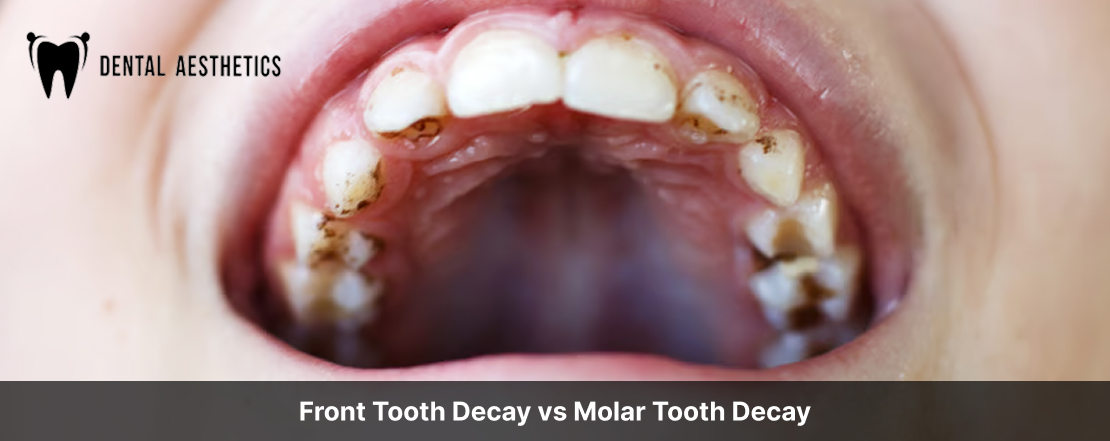
While both front tooth and molar tooth decay involve the loss of basic tooth structures, their locations affect how they are recognized and restored. Front teeth are more visible and, therefore, can affect a person’s appearance. Molars have grooves and chewing surfaces where food and plaque can accumulate.
Decay of front teeth can start at the gum line or at the biting edge of the tooth and can appear as a brown patch, a white spot or a cavity. An esthetic consideration when restoring front teeth is to use tooth-colored material to fill the decayed area, particularly if the decayed area is small and not on the biting surface.
Decay of molars can occur in deep grooves between teeth and can progress unnoticed. These molars can be assessed properly by X-ray. Other teeth with decay in pit and fissure areas can also be assessed by X-ray.
The same thing can be said of both locations: if the decay has progressed beyond the stage of mineral loss, a cavity is formed, and the structure of the tooth has already been lost. Front teeth are also lost if they are affected. Prompt evaluation can help to reduce further loss of the structure of the front tooth.
For adults, the stages of tooth decay can be the same for front and molar teeth. For children’s primary teeth, see Do cavities in baby teeth need treatment?
Stop Early Decay with Fluoride and Dental Care
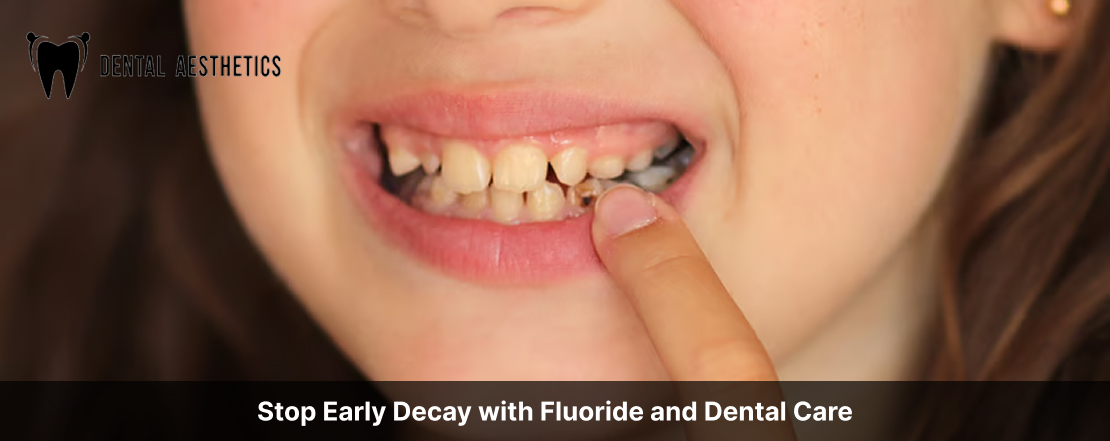
Oral health issues can often be improved or treated if they are caught at an early stage. Because the development of cavities can often be slowed or stopped if the decay is caught at an early stage and the daily hygiene of the person is improved, the exposure to sugars is reduced, and fluoride is employed (even if a cavity is present, these methods can slow decay and prevent further decay, but do not remineralize the cavity and do not replace the need for a restoration). The National Health Service of England (NHS) also advises using toothpaste and floss, as they aid in the removal of plaque.
Build these habits into your daily routine:
Brush thoroughly with a fluoride toothpaste, particularly before bed.
Floss and use an interdental cleaner to remove plaque and food that are stuck between your teeth.
Avoid frequent consumption of sugary foods and beverages.
Attend routine checkups.
Contact your dentist for an examination if you notice the formation of new white spots, have persistent tooth sensitivity, notice a cavity, or experience pain.
Conclusion: Get Tooth Decay Assessed Early at Dental Aesthetics Lahore
Decay can progress from the erosion of enamel to the development of cavities and a pulp infection and abscess. Decay can progress to the point where the infected nerve has to be removed. To prevent this from happening, the tooth needs to be treated before this process becomes more advanced. Early stages of decay can sometimes be reversed; however, an infected nerve requires a root canal treatment.
If you have a persistent toothache, have noticed a dark spot on your tooth, have a tooth with white or brown discoloration, or have sudden sensitivity to heat and cold, contact Dental Aesthetics Lahore. The dentists can examine the tooth and, based on their findings, recommend treatment options and provide a cost estimate.
For more information about dental care in Lahore or to schedule an appointment, contact us. Early evaluation usually gives the patient a better opportunity to make an informed decision before further damage occurs
Frequently Asked Questions
How do you know what stage of tooth decay you have?
There are many causes of oral distress and symptoms, and each tooth can behave differently; just because a person has a symptom of decay does not mean that they are in a certain stage of decay. A dentist can X-ray and examine a tooth to see if the decay and any accompanying symptoms are related to pulp.
Can a Stage 3 cavity be reversed?
No, stage 3 Decay, according to some sources, begins to affect the dentin of the tooth and can no longer be reversed. At this stage, a dentist will need to remove the decayed portion of the tooth and restore it.
Can a very decayed tooth be saved?
Yes, a very decayed tooth can be saved if there is still enough healthy structure and the tooth is otherwise treatable, and a root canal and restoration is performed. Otherwise, it may need to be removed.
Can I remove tooth decay at home?
No. Tooth decay cannot be safely removed at home. Only the enamel of the tooth can be reversed at home with fluoride, changes in oral hygiene and diet. If a physical cavity is present, it needs to be addressed by a dentist. Do not scrape your teeth or use chemicals to remove the decay.
Does a black spot always mean tooth decay?
Not always. Black or brown spots can occur due to stain buildup on the enamel. Only a dentist can tell for sure if the spot is decay.
When should I see a dentist for tooth decay?
You should see a dentist for a new spot, hole, or ongoing food traps, or if you have tooth sensitivity or a toothache. A dental abscess or facial swelling is an emergency, as is difficulty breathing or swallowing.



Request An Appointment
Map
Timings
Monday - Saturday
11:00 am - 9:30pm
Sunday
12:00pm - 8:00pm